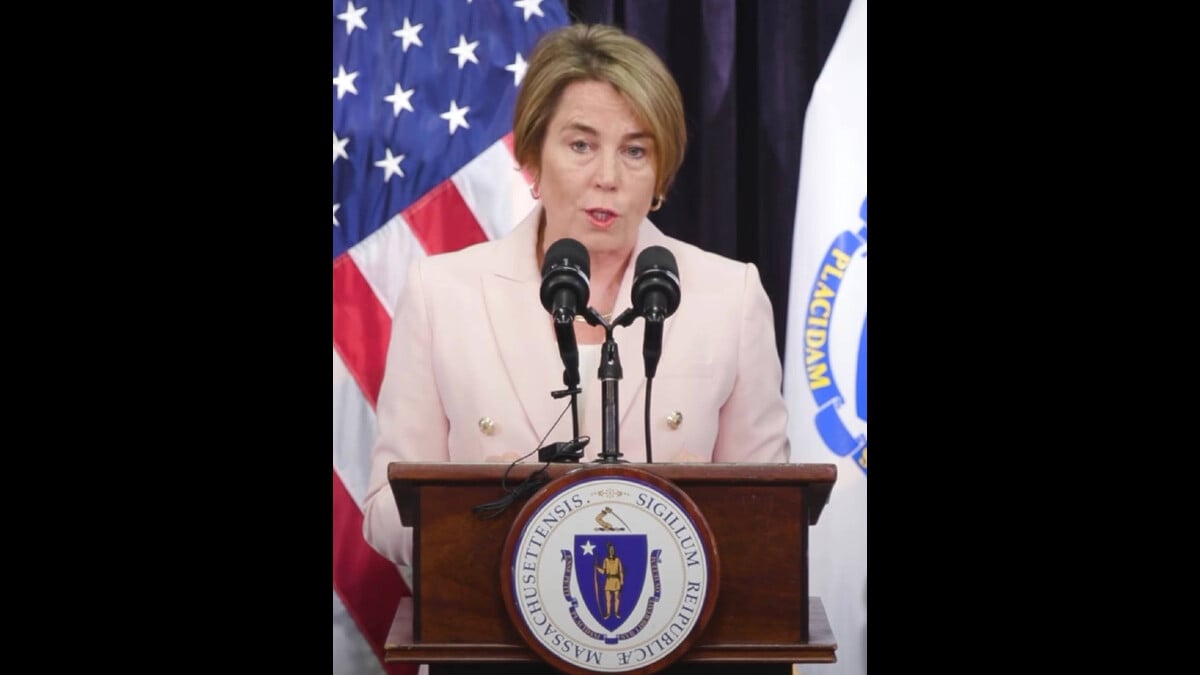
BOSTON — Gov. Maura Healey told the feds to take a number Thursday.
In fresh marching orders to Massachusetts schools, hospitals and houses of worship, the Democrat instructed institutions to bar Immigration and Customs Enforcement agents from any private area unless they turn up clutching a warrant signed by an actual judge — not the administrative paperwork ICE agents typically carry.
Translation: in the Bay State, the door stays shut.
The guidance, rolled out Thursday morning, tells every covered institution to pick one staffer as its ICE point person, write down every brush with federal agents, guard “confidential information” — and slam the door on any agent who shows up without a judge’s signature.
It dropped just one day after the U.S. Department of Justice hauled Massachusetts and three other states into court over policies that hide the license plates of state vehicles from federal immigration agents. The DOJ says that’s obstruction. Healey says the DOJ is dead wrong.
Thursday’s playbook was her next punch.
‘Completely broken’
Healey didn’t sugarcoat the state of play.
“The relationship between the state and federal government used to work, but that’s completely broken right now,” the governor griped to reporters.
“We’re not going to allow them to operate in secret as they take people off our streets without cause.”
MASSDAILYNEWS
STAY UPDATED
Get Mass Daily News delivered to your inbox
ADVERTISEMENT · Interested in advertising?
ADVERTISEMENT · Interested in advertising?
“I wish we didn’t have to be here today to continue to have to defend our residents from unlawful and harmful actions by federal agents.”
Nobody’s arguing the relationship is broken. The fun part is figuring out who did the breaking.
For nearly two decades, ICE and the Bay State played by the same rule the rest of the country runs on: if agents had probable cause, local institutions handed the guy over. That arrangement started cracking under the first Trump term as Massachusetts cities went sanctuary — and it’s gone into overdrive under Healey, who in January signed an executive order banning ICE civil arrests in state buildings and barring state property from being used to stage enforcement.
Since then she’s blocked ICE from registering undercover plates, watched Attorney General Andrea Campbell help launch a snitch-on-ICE portal, and now ordered schools, hospitals and churches to draw up their own how-to guides for turning agents away at the threshold.
It’s a curious kind of “broken” relationship — the kind where one side keeps bolting the door, then gripes that the other side won’t come in.
And the people on the other side of that bolted door are not abstractions. In recent weeks alone, ICE Boston has pulled out of Massachusetts a Brazilian fugitive owing 16 years back home for statutory rape, a Guatemalan illegal migrant accused of raping a child, a Haitian illegal migrant in Fall River with pending kidnapping and strangulation charges, a 66-year-old convicted child rapist hauled from a Massachusetts home, and an illegal migrant who snuck back into the state after being deported in 2017 for child rape. ICE Boston’s April Massachusetts roundup reads like a true-crime appendix.
What the playbook actually demands
Stripped of the bureaucratic gloss, here’s what Healey wants Massachusetts institutions to do:
ADVERTISEMENT · Interested in advertising?
ADVERTISEMENT · Interested in advertising?
- Hand one employee the keys as the lone ICE liaison — every federal request runs through that person.
- Make agents flash a judicial warrant signed by a judge — not the everyday administrative warrant ICE leans on — before setting foot in any nonpublic area.
- Put every ICE encounter in writing.
- Shield “confidential information” from federal asks.
That judicial-warrant demand is the whole ballgame. ICE operations have always run on administrative warrants — in-house agency forms, not orders from a judge. By telling institutions to accept only the judge-signed version, Healey has effectively walled off the back rooms of every school, hospital and church in the commonwealth.
The other half of the squeeze
Beacon Hill is loading the second barrel. Rival sanctuary bills have already cleared the state Senate and House, and lawmakers are now hammering the two versions into one before shipping it to Healey’s desk.
Her Thursday guidance doesn’t need any of that — it’s pure administration, a directive to state-funded outfits on how to behave when the feds come knocking. But if the reconciled bill lands on her desk, today’s strong suggestion hardens into Massachusetts law.
What’s next
The plate lawsuit is just the opening round. The Trump administration has made clear it sees the Bay State’s stance as flat-out obstruction; Healey sees Washington’s as raw overreach. Neither is blinking.
Which leaves every principal, hospital boss and parish priest in Massachusetts holding the same loaded question: when a federal agent shows up to enforce federal law, do you side with the governor — or with the United States immigration code?
Healey’s already told them how to answer.
Loading Comments