
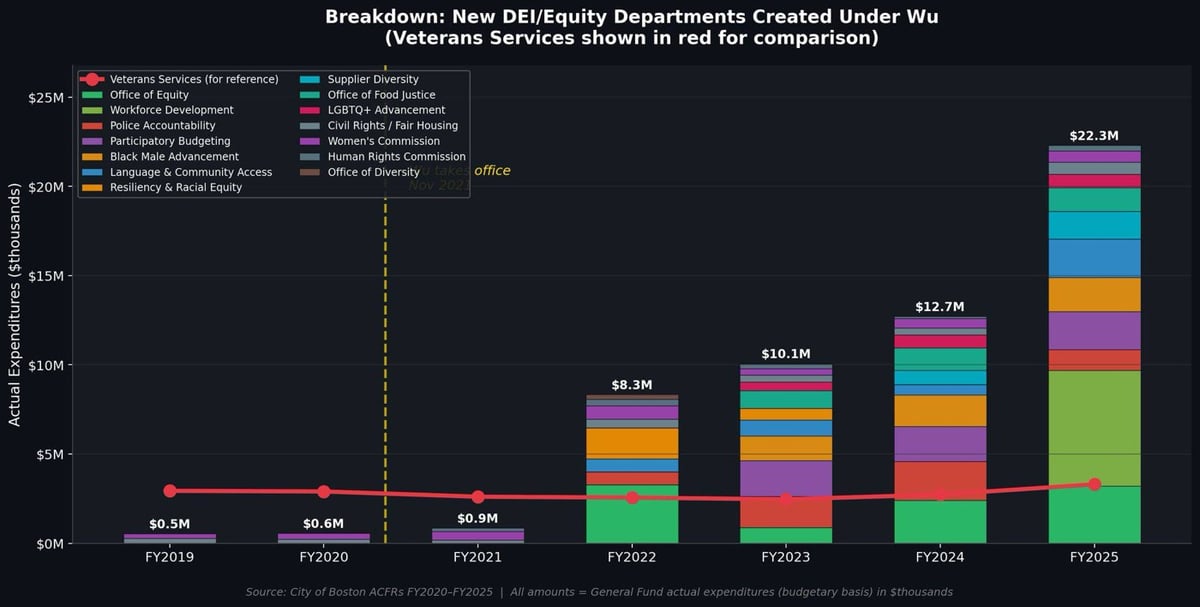
BOSTON — In Mayor Michelle Wu's first year in office, the City of Boston spent $900,000 on the cluster of equity and DEI-themed departments that now define her administration's organizational chart. Four budget cycles later, that line ran to $22.3 million — a 24x increase, driven by fourteen separate offices, commissions and racial-equity initiatives that did not meaningfully exist as a budget category in Boston before she walked in.
Veterans Services, by contrast, did not move.
The chart below — built from the city's own audited financial reports, its Annual Comprehensive Financial Reports (ACFRs) for FY2019 through FY2025, and published by the Massachusetts Data Hub — shows every general-fund dollar Boston has actually spent on those DEI-aligned offices, broken out by year and by department, with Veterans Services overlaid in red as a fairness benchmark.
The 24x
The pre-Wu baseline was a rounding error. In FY2019, the line totaled $0.5 million. In FY2020, $0.6 million. In FY2021 — the budget that ran through her swearing-in in November of that year — $0.9 million.
Then the chart breaks vertical.
- FY2022: $8.3 million — Wu's first full fiscal year in office. Nine new offices on the legend.
- FY2023: $10.1 million.
- FY2024: $12.7 million.
- FY2025: $22.3 million — fourteen separate equity and DEI-aligned offices and commissions, all funded out of the general fund.
MASSDAILYNEWS
STAY UPDATED
Get Mass Daily News delivered to your inbox
ADVERTISEMENT · Interested in advertising?
ADVERTISEMENT · Interested in advertising?
Among the line items inside that $22.3 million total: an Office of Equity, a standalone Office of Diversity, an Office of Black Male Advancement, an Office of LGBTQ+ Advancement, an Office of Food Justice, Resiliency & Racial Equity, Participatory Budgeting, Supplier Diversity, Workforce Development, Language & Community Access, Police Accountability, Civil Rights / Fair Housing, a Women's Commission, and a Human Rights Commission.
Some of those names pre-date Wu. The dollars behind them, with very few exceptions, do not.
The line that did not move
Across the same seven-year window, Boston's Veterans Services department — the city office that exists to make good on the city's obligation to the men and women who served — bumped along between roughly $2.5 million and $3.0 million a year. It is the flat red line on the chart.
In FY2019, Veterans Services was effectively spending more than every DEI office combined. In FY2025, the same Veterans line cost the city about one-seventh of what the DEI cluster cost. Nothing about the underlying population of Boston-resident veterans changed enough to justify that. The priority did.
What this lines up next to
This is the same general fund that, two days ago, Councilor Sharon Durkan killed firefighter cancer-screening funding out of — citing procedure. It is the same general fund Wu and her allies told the firefighters' union there was no money for.
ADVERTISEMENT · Interested in advertising?
ADVERTISEMENT · Interested in advertising?
It is also the same administration that, two weeks ago, drew an official federal discrimination complaint from the U.S. Department of Housing and Urban Development — citing, among other things, a 65% racial-quota housing target, a "racist Christmas party," and banks pressured to lend by race. The DEI departments named in HUD's filing are the same ones whose budget lines this chart traces.
The administration's own FY2026 budget — filed last week — does propose cutting some of these lines back by roughly 20%. Wu's own progressive base is now in open revolt over those proposed cuts. They are angry about the cuts. The chart above is angry about the buildup that made the cuts possible.
Is this where Boston's money should be going?
Stack the receipts side by side and the picture sharpens.
In four years, Mayor Wu's administration has:
- Stood up an Office of Diversity, separate from the Office of Equity, separate from the Office of Black Male Advancement, separate from the Office of LGBTQ+ Advancement, separate from the Civil Rights office, separate from the Human Rights Commission, separate from the Women's Commission. Seven separate boxes on one org chart for what most American cities call an HR department.
- Grown that cluster's annual general-fund spending from $900,000 to $22.3 million — a 24x increase — while quietly adding two or three new commissions every budget cycle.
- Handed Boston homeowners the largest residential property-tax hike in nearly twenty years, followed by double-digit homeowner tax increases every year since.
- Run the city about $50 million into the red on a billion-dollar budget — publicly blamed, with a straight face, on snow.
- Told the firefighters there was no money for the cancer screenings that catch the disease they get from running into burning buildings.
Look at that list, then look at the chart above, and ask: is fourteen DEI-branded offices what Boston taxpayers thought their bill was going up to fund?
Loading Comments