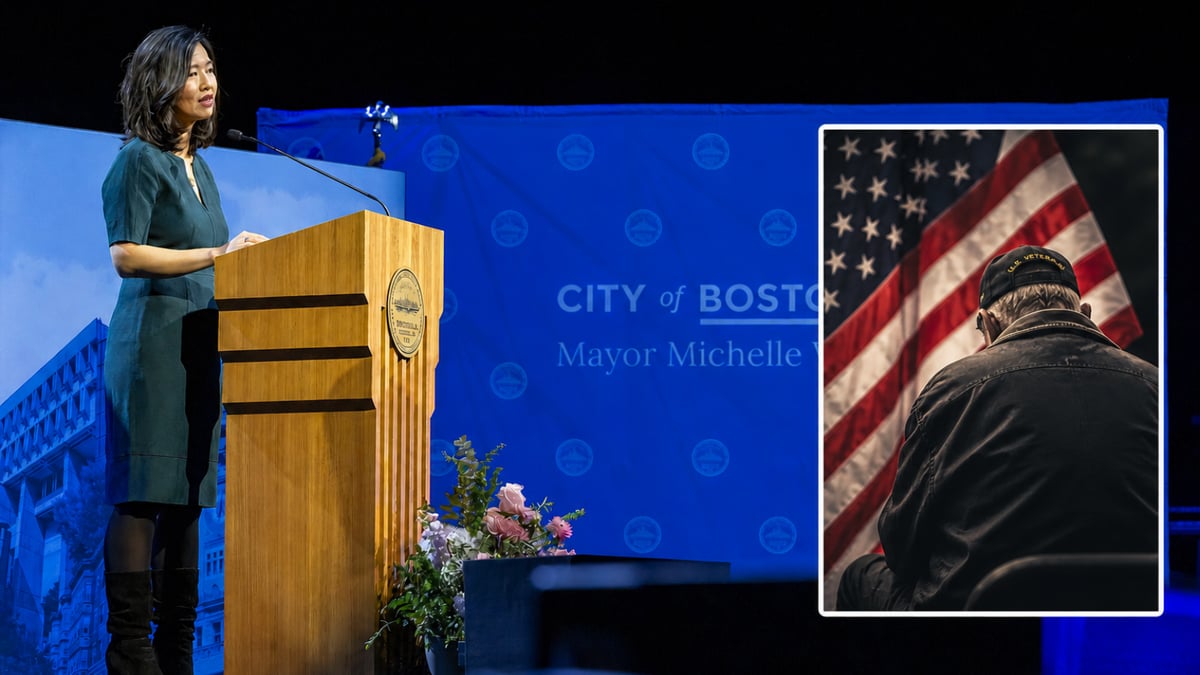
BOSTON — Four days ago, Mayor Michelle Wu stood on the East Boston waterfront and called climate change an "existential threat" to the city, unveiling a multi-billion-dollar 2030 Climate Action Plan she said would help Boston "thrive for generations to come."
Today, her FY27 budget is moving to cut the city's Veterans Department by 14.6% — and the only disabled veteran on the Boston City Council can't believe nobody else is angry about it.
Ed Flynn, the South Boston councilor and Navy veteran, took the floor at Friday's budget hearing to deliver one of the more blistering speeches of the FY27 cycle.
This morning @BOSCityCouncil Budget working session, I testified against the proposed cut to @BostonVets. The recommended budget indicates a 14.6% reduction. Investment in our veterans not only honors their contributions but ensures that no one is left behind. #bospoli pic.twitter.com/Uj4Z4HQ1IP— Ed Flynn 愛德華費連 (@EdforBoston) May 1, 2026
"This is my ninth budget that I've been involved in, and I have to say it's one of the most disappointing when I see a cut of 14% to the veterans department," Flynn said. "We haven't heard city council speak on that issue at all."
He named the people the cut would hit — "African-American veterans, women veterans, women combat veterans, disabled veterans" — and reminded his colleagues that he's the only one of them who fits in the last category.
"I'm shocked that there is not an outcry from this body on cuts to the veterans department," he said.
'Even five cents'
Flynn flies to Washington, D.C. every other month, by his own account, to fight cuts to federal veterans programs under the Trump administration, and came home from one of those trips to find his own city slashing its Veterans Department by nearly 15%.
MASSDAILYNEWS
STAY UPDATED
Get Mass Daily News delivered to your inbox
ADVERTISEMENT · Interested in advertising?
ADVERTISEMENT · Interested in advertising?
"These aren't services," Flynn told the council. "These are programs that veterans earn through their blood, sweat, and tears, and major injuries. We're not giving veterans anything. They've earned these rights."
He went further: "Even five cents cutting the veterans budget — even five cents — sends a message that veterans are just like anybody else, and veterans should accept cuts."
He could not, he said, accept it.
$4.9 billion — but not for vets
Wu's FY27 budget weighs in at $4.9 billion, up 2.1% from FY26, and once healthcare cost increases are stripped out, total city departmental appropriations are decreasing by $20.4 million, or 1.3% citywide. The Veterans Department, by contrast, is being cut 14.6% — roughly eleven times deeper than the average departmental haircut.
Other departments fared even worse, with the Mayor's Office for Immigrant Advancement down 43%, Arts & Culture 27%, Fair Housing and Equity 24%, Economic Opportunity & Inclusion 18%, and the Office of Food Justice 14%. The Office of Participatory Budgeting — the program that drew its own fight earlier this year over 11-year-olds and non-citizens voting on city money — is taking an 11% cut, but still has a $1.89 million budget on the books.
The mayor herself kept all of her own $43,000 raise, her salary climbing from $207,000 to $250,000 effective 2026 — a council-approved increase she did not decline or roll back.
ADVERTISEMENT · Interested in advertising?
ADVERTISEMENT · Interested in advertising?
Two climate offices, one Veterans Department
While the operating budget squeezes nearly every department, Wu's broader climate agenda is on a different trajectory.
The 2030 Climate Action Plan she rolled out on April 27 is a multi-billion-dollar undertaking, with the city's own analysis projecting that the Building Emissions Reduction and Disclosure Ordinance — BERDO — will drive $4.41 billion to $8.15 billion in new spending between 2025 and 2030. The FY26–30 capital plan includes another $75 million for coastal resiliency, and the plan itself was shaped by 208 people, per MDN's prior coverage, while including congestion-pricing studies, building electrification mandates, and grading homes on "compliance scores."
Wu has built parallel climate leadership inside City Hall to match. Brian Swett serves as the city's first Chief Climate Officer, while Chris Osgood runs the Office of Climate Resilience — an office Wu invented in August 2024 — and doubles as her Senior Advisor for Infrastructure. Two climate offices and a Chief Climate Officer to advance the agenda; one Veterans Department to absorb the cut.
What Wu calls 'existential'
At the East Boston rollout last week, Wu was direct about the stakes: "Climate change is here today. Urban heat island is here today. We know that we need to prioritize this going forward, because unaddressed climate change is an existential threat to the city of Boston, and the future of our way of life."
The city of Boston, by her own framing, will spend billions to be ready for that threat. When the council asks the same city for the money to honor the contract it made with the men and women who served in its name, the answer is 14.6% less.
Loading Comments