BOSTON — When cities install dedicated bus lanes down major commercial streets, the small businesses lining those streets tend to lose money — often for years, sometimes permanently. That is what a new peer-reviewed study of transit infrastructure in minority communities documents, and what the record from Toronto's St. Clair Avenue West and San Francisco's Van Ness Avenue corroborates.
Mayor Michelle Wu's $80 million Blue Hill Avenue redesign — a federally funded center-running bus lane through Roxbury, Dorchester and Mattapan — proposes to run the same experiment on a corridor whose small businesses are overwhelmingly Black-owned. Residents have asked Washington to rescind the federal grant. City councilors have called the plan a potential civil-rights violation. The city's own traffic study projecting the redesign's impact has never been publicly released.
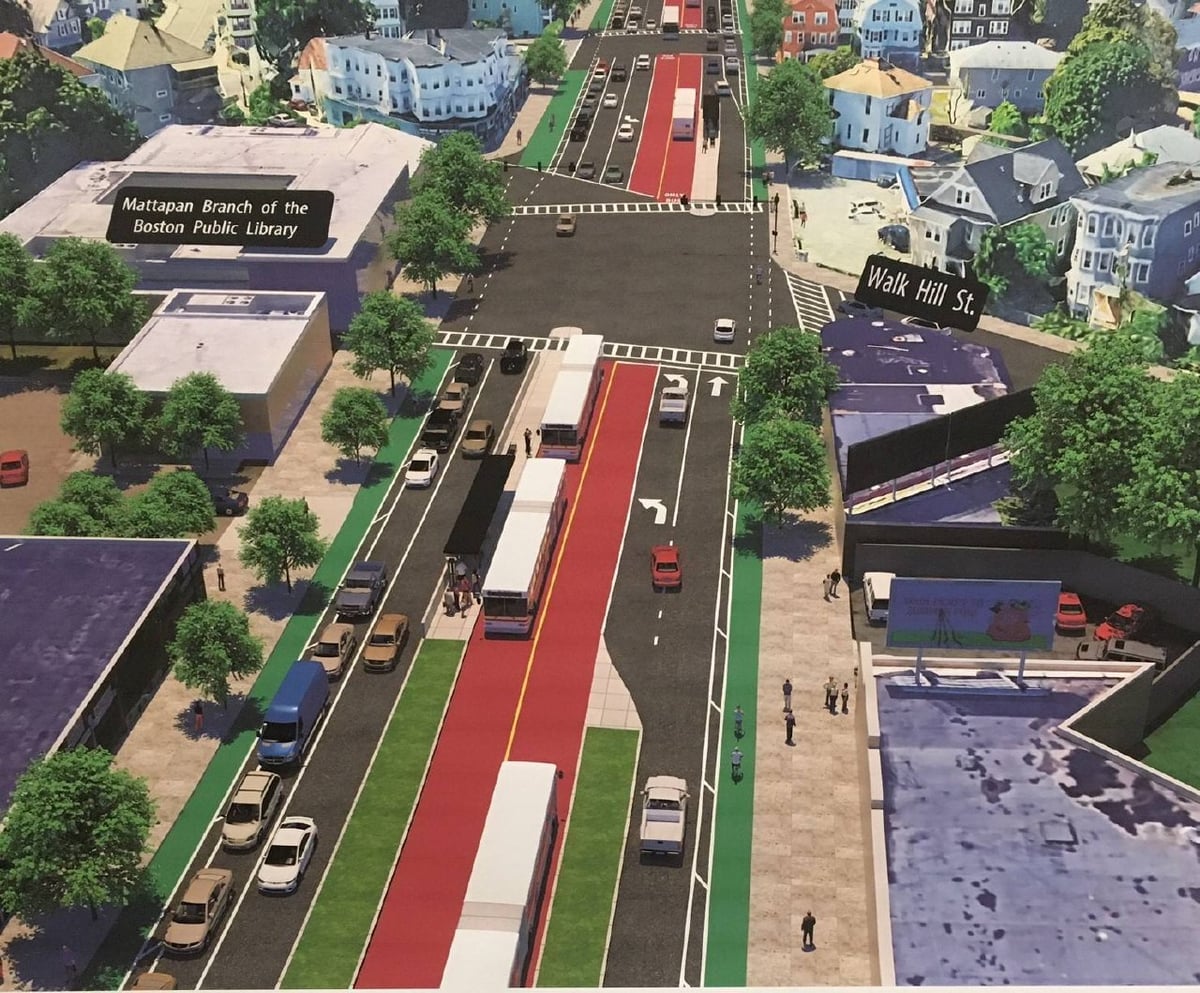
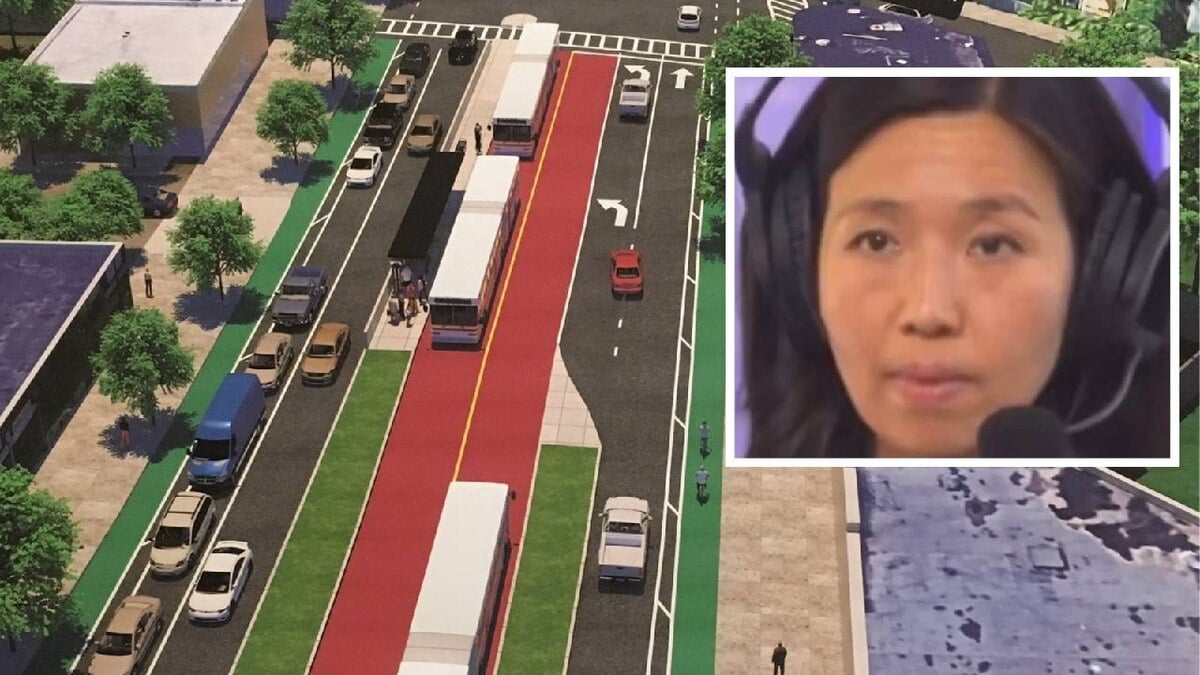
The City of Boston's rendering of the Blue Hill Avenue redesign, showing the center-running bus lane past the Mattapan Branch of the Boston Public Library at Walk Hill Street. Image: City of Boston.
The academic and comparative evidence explains why the pushback is not going away.
The study
Published in the peer-reviewed journal MDPI Societies on June 24, 2026, "Transit Infrastructure Policy and Displacement Risk in Latina/o Communities: An Etiological Qualitative Analysis" examined a transit infrastructure intervention in a historically marginalized minority community and documented the mechanisms by which it produced displacement risk during implementation. The authors described what they called "commercial precarity" — a pattern of corridor small businesses losing customers, foot traffic, and operational viability during and after the buildout of the transit project.
The community the study examined was Latino, not Black. The mechanism it documents — public transit infrastructure landing on a minority-community commercial corridor with predictable damage to the small businesses lining it — is the same one Blue Hill Avenue's business owners have been asking City Hall to take seriously.
The case history
Toronto's St. Clair Avenue West was closed for construction in 2005 to build a raised, protected streetcar right-of-way through the middle of a mixed residential-commercial corridor. Construction ran through 2010. The final design took the two center lanes for transit and left one general-traffic lane in each direction.
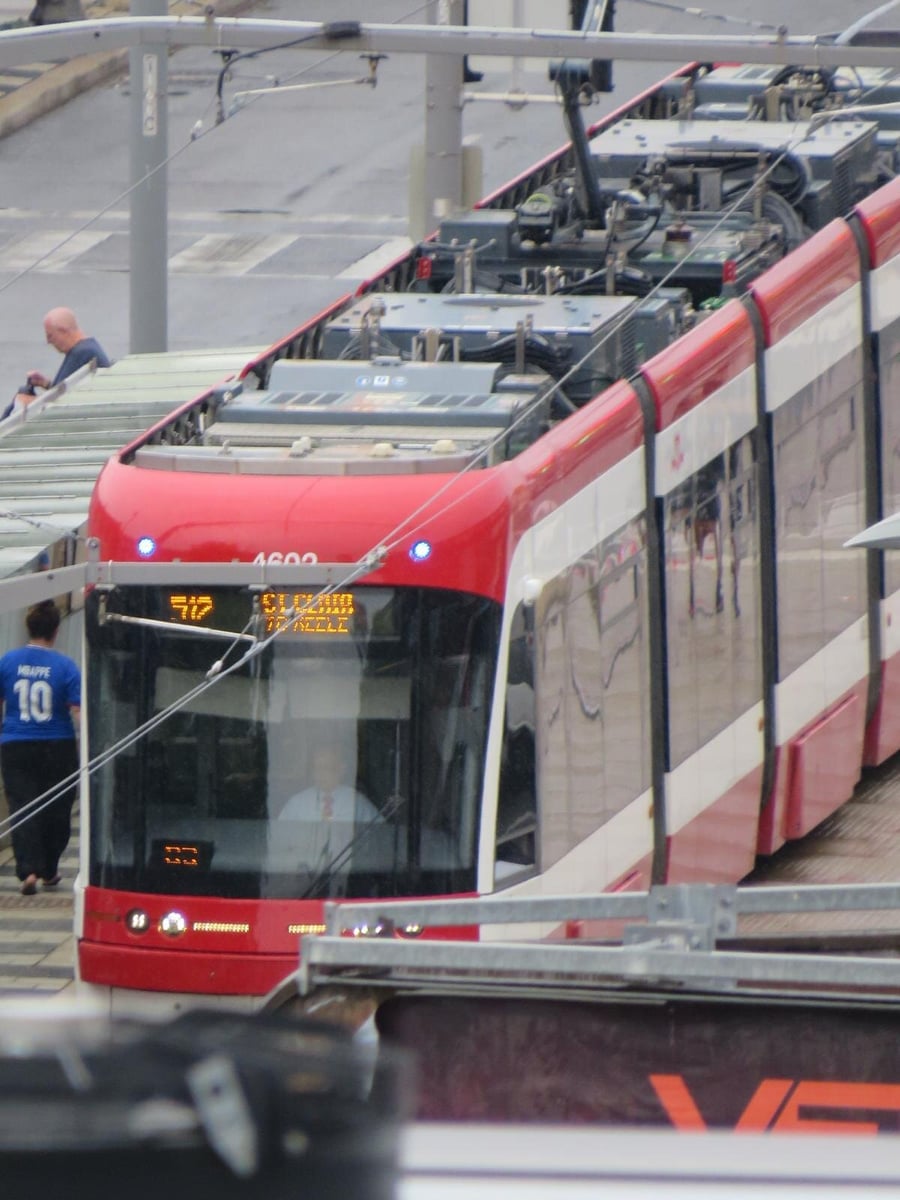
A TTC streetcar on St. Clair Avenue West's dedicated right-of-way, 2024. The corridor's small merchants told the CBC the redesign hurt their businesses for years. Photo: Ammaar127 / Wikimedia Commons (CC0).
Local small businesses that survived construction found that the redesigned road brought fewer customers driving through — a roughly 10 percent drop in cars during rush hour, according to the transit agency's own follow-up report — and that the customers who did arrive had a harder time parking. The CBC returned to St. Clair years after the ribbon-cutting to interview merchants, and found longtime shop owners still using the redesign as a cautionary tale.
"I've noticed a big difference in my bottom line," Winston Hosang, owner of Ellington's Music & Cafe on St. Clair, told the CBC. "If you haven't been here for over 10 years, your chance of survival I would say is pretty slim." Rose Signorile, whose 45-year-old shop Quality Paint sits along the corridor, told the network her business "still hasn't recovered" from the redesign nearly a decade after construction ended.
MASSDAILYNEWS
STAY UPDATED
Get Mass Daily News delivered to your inbox
ADVERTISEMENT · Interested in advertising?
ADVERTISEMENT · Interested in advertising?
San Francisco's Van Ness bus rapid transit project ran into every failure mode a bus-lane redesign can hit — decades of planning delays, $37 million in cost overruns, incorrect utility maps, and a construction footprint that dragged on far past its original schedule. Corridor businesses paid the tab.
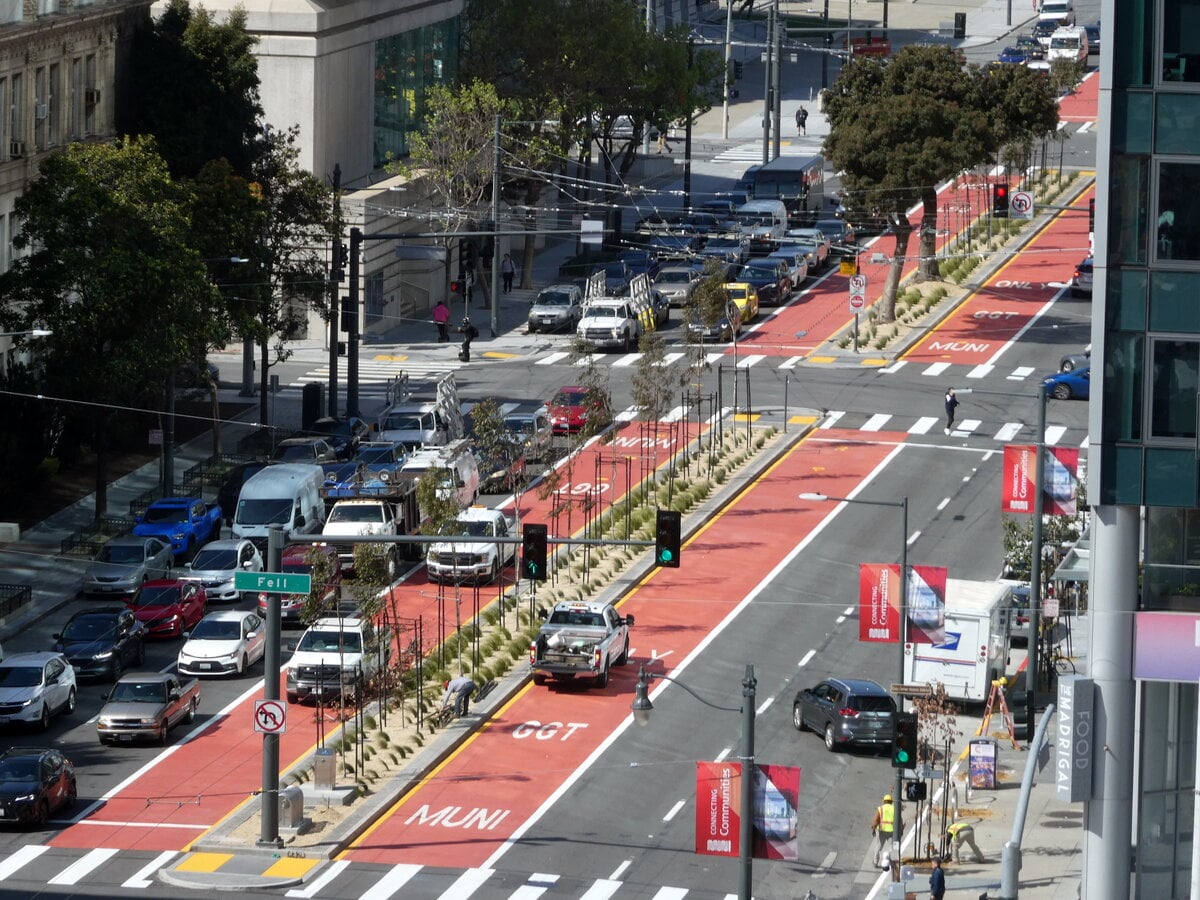
The Van Ness bus rapid transit corridor in San Francisco, one month before its April 2022 opening. Corridor businesses reported roughly 10 percent immediate sales declines during construction. Photo: Pi.1415926535 / Wikimedia Commons (CC BY-SA 4.0).
Restaurants on the corridor reported roughly 10 percent immediate sales declines with the onset of construction, according to reporting by the San Francisco Standard, before the pandemic layered further damage on top. San Francisco's own Controller's Office quantified the pattern in a companion study of similar city infrastructure projects, finding a 12 percent drop in sales tax collections along the West Portal corridor during a comparable buildout. City Hall ultimately allocated $5 million — $4 million in grants and $1 million in low-interest loans — to try to keep Van Ness businesses afloat during construction. Local merchants told reporters the checks did not begin to cover the lost revenue. The corridor was rebranded in the local press as "Van Mess."
Blue Hill Avenue
The neighborhoods along Blue Hill Avenue's commercial corridor — Grove Hall through Mattapan Square — are among the most heavily Black and Latino in Boston, and the small businesses that line the avenue are the corridor's economic and social spine. The barber shops. The Caribbean and Cape Verdean restaurants. The hair salons, the auto-repair shops, the corner markets, the day cares. Many of them are second- and third-generation family businesses. They are what a working-class Black Boston household spent decades building. For a lot of families, the storefront is the primary asset on the household balance sheet.
That is where the numbers get hard to look at. The Federal Reserve Bank of Boston's 2015 report The Color of Wealth in Boston put the median net worth of a U.S.-born Black Boston household at $8. Not eight thousand. Eight dollars. The comparable white household figure in the same study was $247,500. A decade later, no serious study has found that gap has meaningfully closed.
The small merchants in the Toronto and San Francisco case studies were not Black-owned in the proportion Blue Hill Avenue's are, and they were not carrying that kind of headwind. On this corridor, the same construction disruption and the same parking loss would land on the business community in Boston with the least financial cushion in the city to absorb them — and on the families whose modest household wealth is tied up in those storefronts. When a paint shop on St. Clair Avenue West took nine years and counting to recover, its owner still owned a shop. When a Blue Hill Avenue barber closes, the family behind that shop can lose the only wealth they have.
The 2,150-plus residents who signed the petition to Sean Duffy were not asking for special treatment. They were asking the city that took $80 million in federal money on their behalf to first release the traffic study that predicts what happens when the shovels hit the ground. Wu's own City Hall has that study. It has not shown it to the community whose businesses it will affect.
This is the pattern. When Blue Hill Avenue residents asked Mayor Wu to meet with them about the plan before construction begins, she went quiet. When the councilors representing the corridor publicly asked her to release the traffic study, she went quiet. When 2,150 of those residents took the extraordinary step of signing a petition to Washington asking Sean Duffy to rescind the federal money — because their own mayor would not answer them — she went quiet. On ceremonial matters — flag raisings at City Hall, ribbon cuttings, national interviews about how progressive Boston is — Wu has been anything but quiet. On the specific concerns of the specific residents she claimed to represent, she has not been.
ADVERTISEMENT · Interested in advertising?
ADVERTISEMENT · Interested in advertising?
Blue Hill Avenue businesses have spent years asking for those numbers. The people who own them, and the families who depend on them, deserve to see them.
The alternative
Two Boston city councilors — Brian Worrell and Miniard Culpepper — have offered the constructive alternative. Their pitch: extend the Orange Line from Ruggles to Mattapan Square with underground stops at Nubian Square, MLK Boulevard, Grove Hall, Franklin Park Zoo, Harvard Street–Blue Hill Avenue, Morton Street–Blue Hill Avenue, Walk Hill Street–Blue Hill Avenue, and Mattapan Square itself.

Boston City Councilors Brian Worrell (District 4, left) and Miniard Culpepper (District 7, right) have proposed extending the Orange Line from Ruggles to Mattapan Square as the alternative to the Blue Hill Avenue bus-lane redesign. Photos: City of Boston.
"When you look at the different rail investments around Boston and not in the Blue Hill Avenue corridor, that's what you call a disparate impact," Culpepper said in an interview with Boston.com. Worrell framed it as a matter of respect: "So if they don't want the center-running bus lane, let's provide them with multiple different options."
The transit-advocacy group TransitMatters immediately dismissed the proposal. Executive director Caitlin Allen-Connelly called it a "distraction" from immediate bus improvements. Staffer Cole Lewis told Boston.com: "We don't see it as a very serious transit proposal."
That is the tell. The same downtown transit lobby that wants the center-running bus lane installed on top of Blue Hill Avenue's Black-owned small businesses does not want the community to have the higher-capacity rail alternative that would serve every neighborhood along the corridor without touching a single storefront.
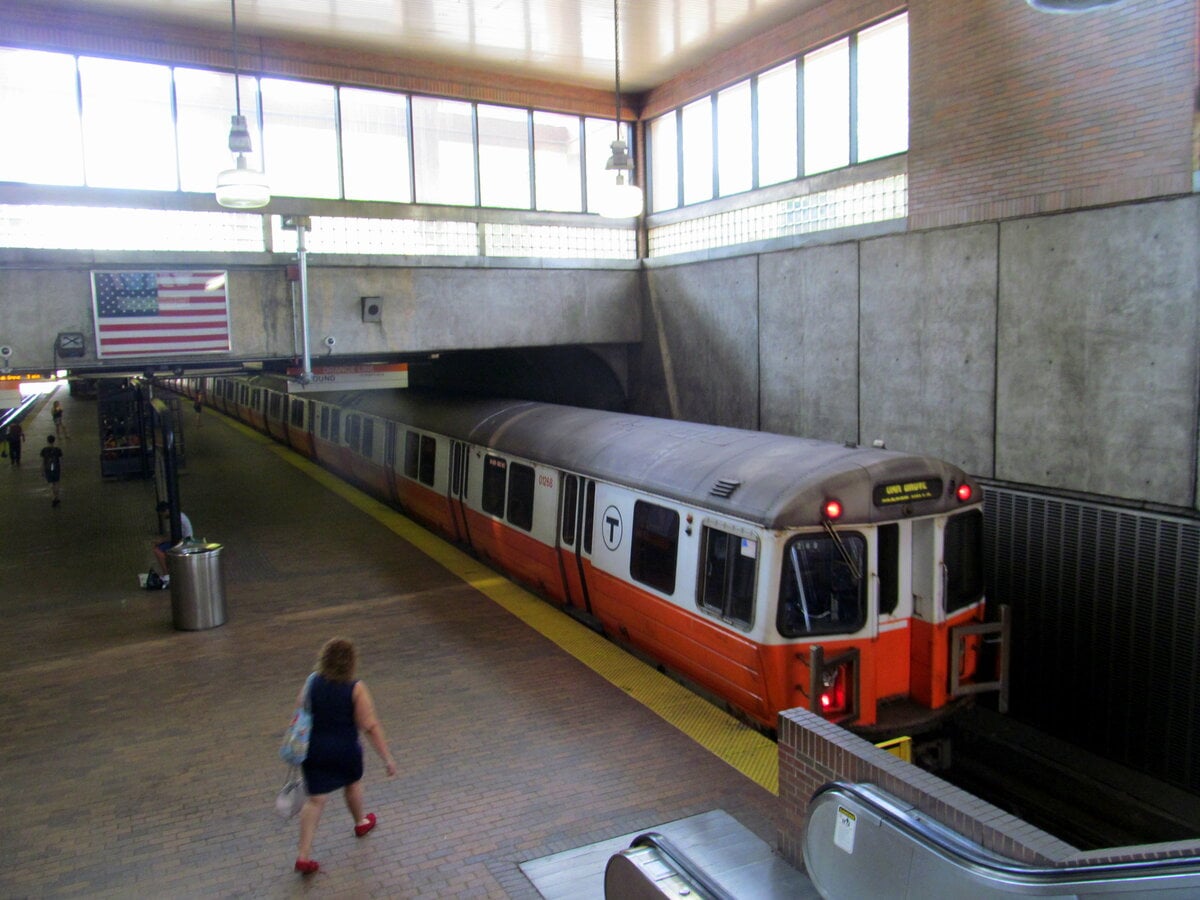
An MBTA Orange Line train at Stony Brook station. Worrell and Culpepper's proposal would extend the line from Ruggles to Mattapan Square with eight new underground stops. Photo: Wikimedia Commons.
An Orange Line extension to Mattapan Square would be a huge win for everyone, and especially for the community that has spent generations being told it will get quality rail transit next — after every other neighborhood. Riders would get faster, higher-capacity, weatherproof transit. Corridor businesses would keep their curbs, their parking, and their sidewalks. And the historic disparity in rail investment between white Boston neighborhoods and Black Boston neighborhoods — the disparate impact Culpepper named — would finally start to close.
It is a 15-to-20-year build. That is a long time. It is also the right timeline for the right project. Blue Hill Avenue's Black community has waited long enough. They deserve a project designed with their businesses and their families in mind — not one designed for them, over their objections.
Loading Comments