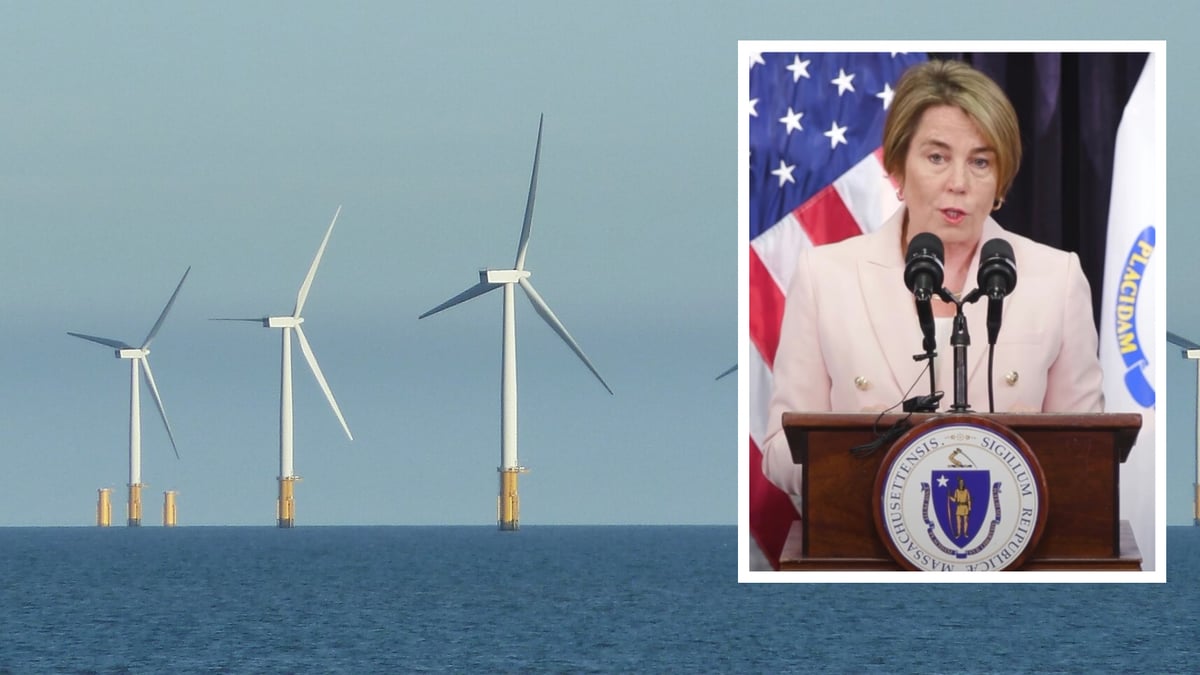
The failure of offshore wind development has prompted the Massachusetts Legislature to double down on its efforts in that direction. The Senate plans to take up a bill Wednesday entitled "An Act to save people money, repair the climate and grow the economy" that proposes an enormous increase in offshore wind power, and also shifts project risks from developers onto ratepayers.
The state currently has a statutory target to procure 5,600 megawatts (MW) of industrial offshore wind by June 30, 2027. Having secured only 800 megawatts of offshore wind capacity so far, with future projects delayed or uncertain, the Senate bill is proposing raising the procurement target to an incredible 10,000 MW by 2040. This is a very bad plan.
Offshore wind costs roughly 2.5 times as much as onshore wind, at around $2 million per MW. That makes a 10,000 MW target roughly a $20 billion commitment that Massachusetts ratepayers will ultimately be asked to fund. Governor Maura Healey and legislative leaders continue to tout offshore wind as "reliable and affordable," neither of which is true.
Wind power is as unreliable as the weather. It takes sustained wind of over 30 miles per hour to get full power from a wind generator, and this seldom happens off Massachusetts. But below 10 mph no substantial power is produced, and this happens frequently, sometimes for several days. In between, the electricity output varies constantly with the wind.
As I write this, wind speeds around Cape Cod, near where many offshore wind turbines would operate, are forecast to remain below 10 mph for most of the coming week. The one exception is a single day reaching roughly 15 mph. During a stretch like that, a $20 billion offshore wind buildout would produce only a small fraction of its rated capacity, even as electricity demand could remain high.
At the same time, Boston is forecast to see four days above 90 degrees, with one approaching 100. That is exactly when demand for electricity becomes most urgent. This is not a coincidence. Heat waves are often associated with stagnant high-pressure systems, which can also mean weaker winds and lower wind output.
MASSDAILYNEWS
STAY UPDATED
Get Mass Daily News delivered to your inbox
ADVERTISEMENT · Interested in advertising?
ADVERTISEMENT · Interested in advertising?
That is not reliability. Reliability means having power available when people need it most. Offshore wind, by contrast, depends on weather conditions that cannot be scheduled, dispatched, or guaranteed.
Batteries cannot save the day, as their potential contribution in cases like this is trivial at best. Massachusetts already has a program to underwrite 5,000 MW of batteries, also costing billions of dollars. A typical grid-scale battery provides about four megawatt-hours (MWh) of storage per MW of battery capacity. At that scale, 5,000 MW of batteries would provide roughly 20,000 MWh of storage, enough to back up 10,000 MW of offshore wind for only about two hours. Backing up several days of low wind output would require vastly more storage, at staggering cost.
Nor is offshore wind affordable. It typically costs around $120 per MWh, while Massachusetts wholesale power prices are more like $45 most of the time. The state does see prices near $120 during peak need because the supply of natural gas for power generation is artificially constrained by the lack of new natural gas pipelines. But the obvious solution here is to increase our natural gas supply, not build more incredibly expensive, unreliable wind turbines.
If offshore wind were truly becoming affordable on its own, Beacon Hill would not need to allow contract renegotiations, extend permits, and create new ways for the state to financially support troubled projects.
ADVERTISEMENT · Interested in advertising?
ADVERTISEMENT · Interested in advertising?
Massachusetts residents need affordable, reliable energy, not a costly rescue plan for an offshore wind industry that has already failed to deliver on its promises. Rather than doubling the target and shifting more risk onto ratepayers, Beacon Hill should be focused on power sources that can lower costs, operate when needed, and keep the lights on.
If offshore wind requires federal subsidies, state subsidies, contract renegotiations, permit extensions, and taxpayer co-investment just to survive, when do lawmakers conclude the economics simply don't work?
The Senate bill may claim to save people money, repair the climate, and grow the economy. In reality, it would ask Massachusetts families and businesses to pay more for a less reliable electric grid.
Urge your state senator to reject this bill by taking action here.

Laurie Belsito is the Policy Director at Massachusetts Fiscal Alliance.
Loading Comments