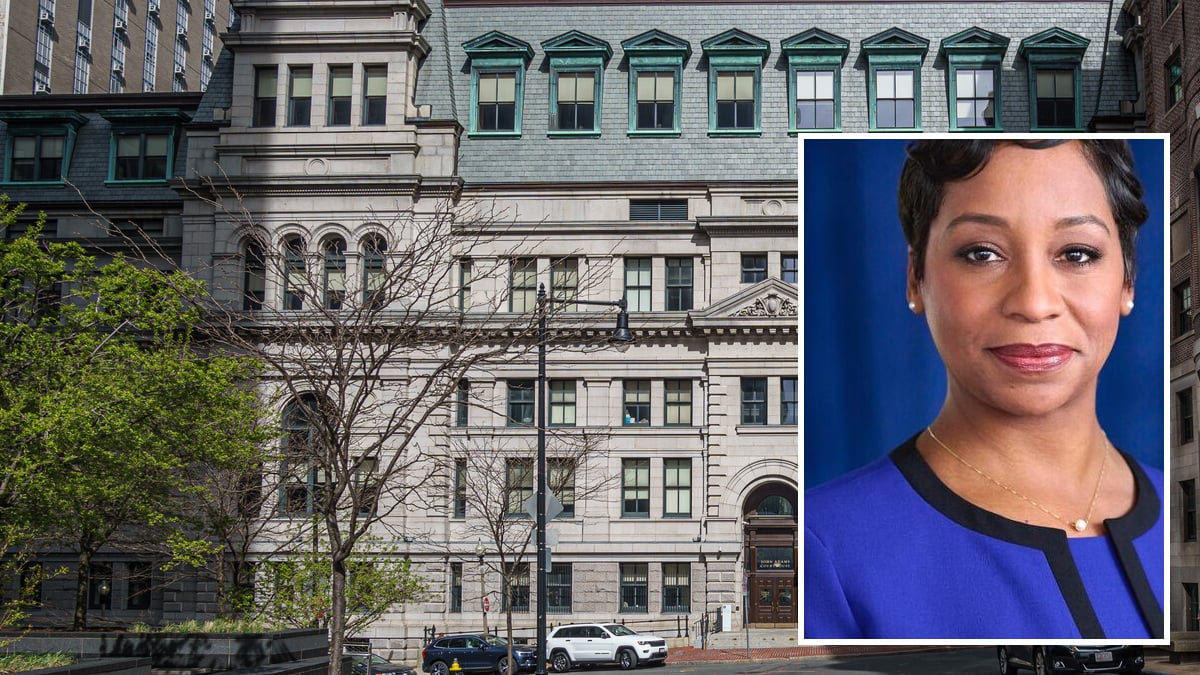
BOSTON — Months after siding with the state Legislature against Auditor Diana DiZoglio's voter-approved authority to audit Beacon Hill, Massachusetts Attorney General Andrea Campbell is back in statewide headlines — this time after a unanimous Supreme Judicial Court ruled Thursday that her office's summary of a 5%-to-4% income tax cut ballot question was "significantly misleading," striking the question from the November 2026 ballot and denying Massachusetts voters a chance to decide on a cut that 65% of residents told pollsters they supported.
"The summary's contrary statement is not a minor imprecision. It is significantly misleading and likely to influence voters," Justice Serge Georges Jr. wrote for the court.
The decision dealt a blow to business groups who had argued Massachusetts is too expensive for residents and employers. Union and legislative-leadership opposition had estimated the tax cut would reduce state revenues by approximately $5 billion a year, the Boston Globe reported.
What Campbell's summary missed
Under Article 48 of the Massachusetts Constitution, the Attorney General is required to prepare a "fair and concise" summary of every ballot question before it goes to voters. Campbell's office did so for this proposal — and the SJC ruled it failed the constitutional "fair" test.
The legal flaw: Campbell's summary told voters the proposed tax cut would not lower the state's long-term capital gains tax rate. The court ruled that if the measure were implemented as written, the cut actually would lower that rate — a factual error the SJC said was "significantly misleading."
"The Attorney General therefore did not provide a 'fair' summary as required by [the state Constitution], and the initiative petition may not appear on the 2026 statewide election ballot," Georges wrote.
MASSDAILYNEWS
STAY UPDATED
Get Mass Daily News delivered to your inbox
ADVERTISEMENT · Interested in advertising?
ADVERTISEMENT · Interested in advertising?
What voters lost
The blocked question would have reduced the Massachusetts income tax rate from 5% to 4% over a three-year phase-in. A statewide poll cited in news coverage of the ruling showed 65% of Massachusetts residents supported the cut.
The petition was led by Lew Finfer, a longtime community organizer from Dorchester who, with allies, gathered the signatures required to place the question on the ballot.
Massachusetts residents pay one of the higher state income-tax rates in New England. Connecticut, New Hampshire (which taxes only investment income), and Rhode Island all have lower or no comparable broad-based wage tax. The 5%-to-4% reduction would have moved Massachusetts toward the bottom of the regional pack on income-tax burden.
A unanimous court — including Healey appointees
The ruling was issued unanimously by the seven-justice SJC. The current bench includes both Republican appointees of former Governor Charlie Baker — Chief Justice Kimberly Budd, Justice Scott Kafker, Justice Serge Georges Jr., and Justice Dalila Wendlandt — and Democratic appointees of current Governor Maura Healey, including Justice Gabrielle Wolohojian.
ADVERTISEMENT · Interested in advertising?
ADVERTISEMENT · Interested in advertising?
No justice dissented. The finding that Campbell's office wrote a "significantly misleading" summary was the unanimous position of the court, regardless of which governor appointed which justice.
Campbell, the Legislature audit, and a pattern
This is not the first time Campbell's office has been a point of friction on a voter-approved direct-democracy measure. State Auditor Diana DiZoglio won the 2024 ballot question (Question 1) granting her office authority to audit the Massachusetts Legislature. The Legislature has refused to comply, and Campbell's office has declined to take enforcement action against the legislative leaders blocking the audit.
In both cases, the practical effect of Campbell's office's posture has been the same: a measure Massachusetts voters either approved or wanted to vote on did not get its full effect.
Campbell, who took office in January 2023, is up for reelection in 2026.
This is a developing story.
Loading Comments