BOSTON — They are on Mass Ave. They are on Boylston, on Newbury, on Commonwealth. They are on the brick sidewalks of the South End and three abreast inside the Southwest Corridor. They are blasting through reds at Berkeley and Stuart at 28 miles an hour with insulated food bags strapped to the back; they are going the wrong way down Beacon at midnight without a single light on; they are weaving past strollers on the Greenway.
They are unregistered. They are uninsured. They carry no plate. They pay nothing — not the registration fee that puts you on the road, not the excise tax that pays for the road they're riding on. And under current Massachusetts law, there is virtually nothing the police can do to make any of that change.
Beacon Hill, at long last, appears to have noticed.
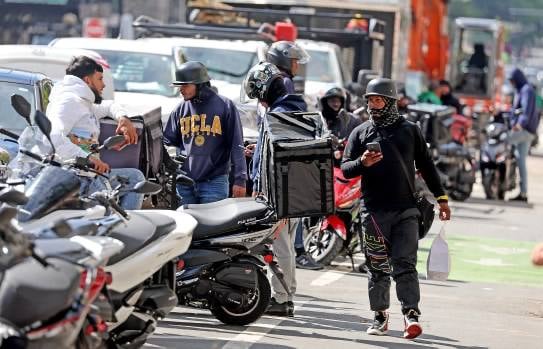
A typical scene on a Boston street — scooter and moped delivery riders staged in the road. Photo: Boston Herald.
The Ride Safe Act — formally, An Act to Enhance the Safe Use of Micromobility Devices, S. 3077 — was filed on May 4 and would, for the first time in Massachusetts, treat the highest-powered e-bikes and motorized bicycles roughly the way the state already treats every other motor vehicle on the road. Annual registration. A license plate or sticker. Liability insurance. Helmets. And a ban from the bike lanes and recreational paths they have effectively colonized.
It is also, in a Beacon Hill near-miracle, already bipartisan within the Democratic caucus — both chairs of the Joint Committee on Transportation came out for it before the committee has even taken it up.
Before you call this another money grab
Read the structure first. The Ride Safe Act does not touch the suburban recreational rider — the Lexington dad on a Class 1 e-bike on the Minuteman, the Brookline retiree on a pedal-assist commuter. The bill exempts the entire bottom tier — traditional bikes, Class 1 and Class 2 e-bikes, low-speed kick scooters — from registration and insurance altogether.
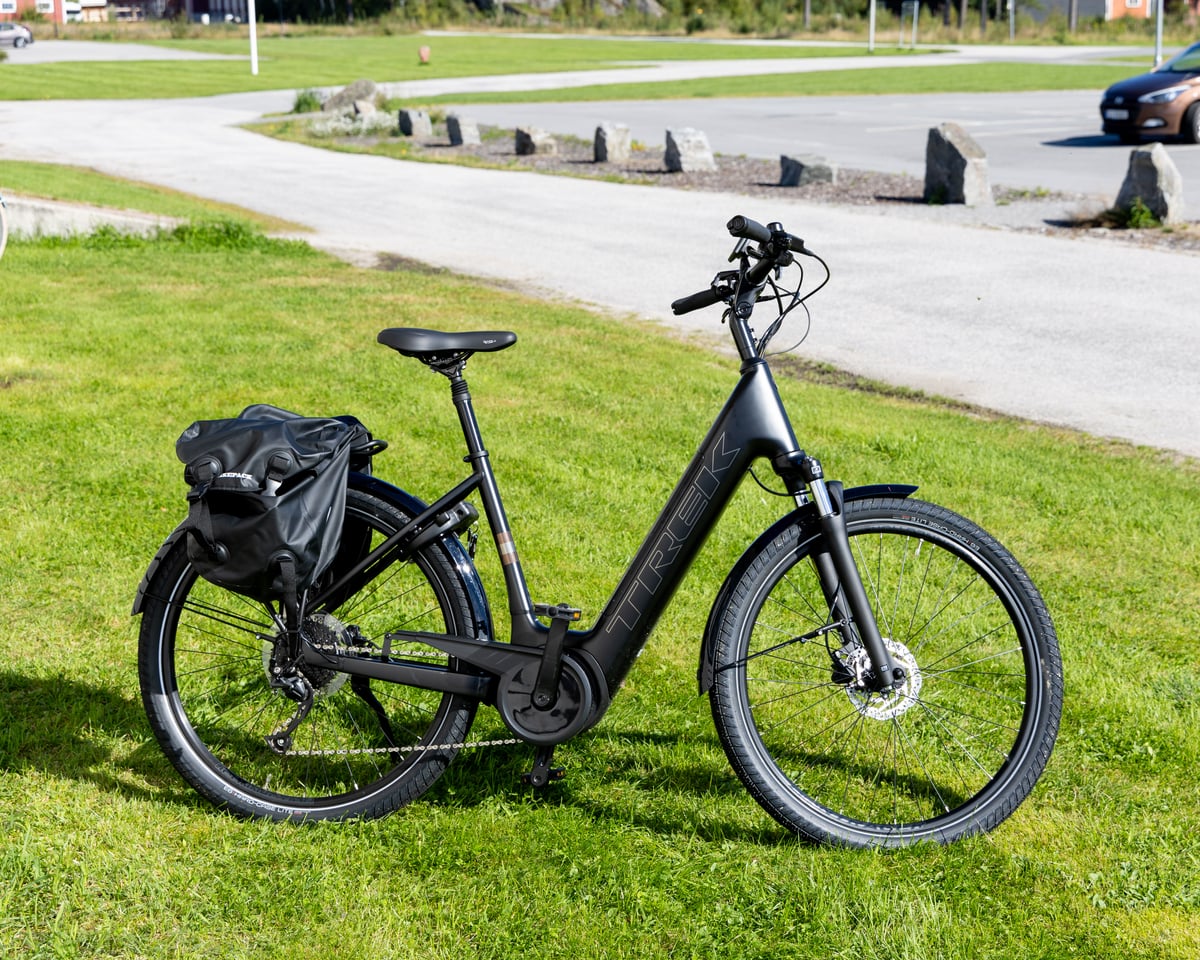
A Trek Verve+ pedal-assist commuter e-bike — the kind of Class 1 device a suburban Massachusetts commuter actually owns. Under the Ride Safe Act, this bike is a Tier 0 device and is completely exempt from the new registration and insurance requirements. Photo: Jarle Hammen Knudsen / Wikimedia Commons (CC BY-SA 4.0).
What it regulates is what has actually happened to Boston: the unplated 40-mph delivery moped jumping the curb on Boylston, the Tier 3 e-bike weaving through pedestrians on the Greenway, the wrong-way kid on a Sur-Ron blowing through Mass Ave traffic. MDN supports drawing that line. We would not support sweeping the suburban rider into the same net — and the bill, to its credit, does not.
What the bill actually does
MASSDAILYNEWS
STAY UPDATED
Get Mass Daily News delivered to your inbox
ADVERTISEMENT · Interested in advertising?
ADVERTISEMENT · Interested in advertising?
The Ride Safe Act covers more than e-bikes. The bill sweeps in e-bikes, gas-powered mopeds and stand-up electric scooters together — the full menu of what's been blasting through Boston intersections — and sorts them by top speed:
- Require annual registration for every motorized device in the Commonwealth, with a sticker or plate "bearing a distinctive number" issued by the registrar.
- Mandate liability insurance — owners must present a certificate of compulsory liability coverage before a device can be registered.
- Sort everything into four speed tiers. Tier 0 (≤20 mph, traditional bikes and Class 1/2 e-bikes) and Tier 1 (21-30 mph, Class 3 e-bikes) keep ordinary bike-path access. Tier 2 (31-40 mph) and Tier 3 (>40 mph) — the fast mopeds and souped-up delivery scooters — get restricted to roadways with stricter rules.
- Ban the higher-tier devices from bike lanes and off-street recreational bicycle paths — meaning the Esplanade, the Minuteman, the Charles River paths and every painted-line bike lane in the city.
- Require helmets for every rider and passenger on a Tier 1 through Tier 3 device, regardless of age. Anyone under 16 must wear one on any e-bike.
The bill goes to the Joint Committee on Transportation on May 28. If it passes and is signed, the rules take effect January 1, 2028.
Without a statute to lean on, BPD has been reduced to periodic Operation Safe Scooter sweeps — towing what they can, summonsing what they catch, with no power to require registration, insurance or a plate. The Ride Safe Act would give them that power.
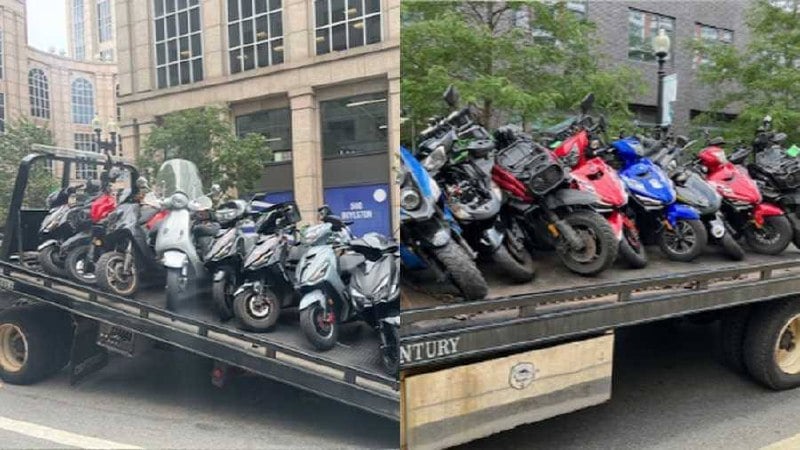
Scooters and mopeds seized by Boston Police during an Operation Safe Scooter sweep, lined up on flatbed tow trucks. Photo: Boston Police Department.
Paying what they owe
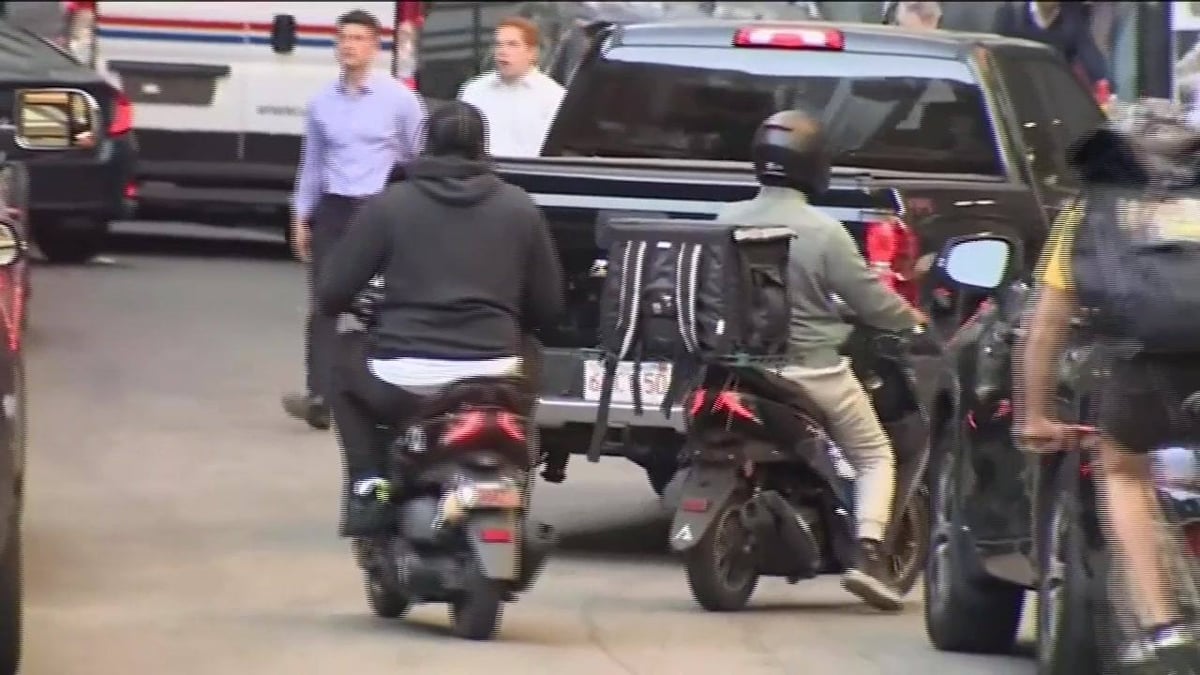
Unplated scooter and moped riders weaving between vehicles on a Boston street — sharing the same asphalt that car owners are required to pay registration, insurance and excise to use.
If you own a car in Massachusetts, you do not get to use the road for free. You pay the RMV for registration, you pay for compulsory liability insurance, and every January you pay your city a motor-vehicle excise bill that goes straight into the municipal budget that paves your road.
ADVERTISEMENT · Interested in advertising?
ADVERTISEMENT · Interested in advertising?
That same budget has spent the last decade building out Boston's growing network of separated and painted bike lanes — Boylston, Mass Ave, Cambridge Street, Tremont, Brighton Ave, Comm Ave, Beacon Street — squeezing car traffic to do it. Every one of those lanes was paid for, in part, by the excise check the car owner stuck behind a 28-mph delivery moped writes every January. The scooter rider in that lane has put in nothing — free-riding on infrastructure paid for by the very car owners he is now cutting in front of.
The Ride Safe Act would close that gap — not by inventing a new tax, but by making the scooter army pay the same share that every legal driver already pays. Once the bike is registered with the RMV, Chapter 60A automatically pulls it into the same annual excise. Same road, same bike lane, same rules, same bill.
Not everyone is sold
Republican gubernatorial candidate Mike Minogue, the former CEO of Danvers-based heart-pump maker Abiomed — whose 2022 sale to Johnson & Johnson left him with a reported nine-figure net worth in the $200-million range — framed the bill on X as "Maura taxes. Maura Spending."
It is not clear whether Minogue — who recently flew over Boston in a helicopter and declared from the air that the city's downtown housing-conversion plan was "developing the next slum" — has actually stood on the Boylston Street crosswalk where the unplated moped packs run the reds. If he had, he might notice that, if anything is making Boston feel like a slum to the people who actually live in it, the lawless scooter army blasting through every intersection is doing a generous share of the work.
It is also a view that, judging by the replies, even self-identified small-government voters in the city of Boston do not appear to share.
"Normally, I would be against more government overreach, but in this case I am in agreement with her," BostonLady29 replied to Minogue. "I have to pay excise taxes & the bikes/scooters/mopeds are everywhere & don't pay. If they are on the roads they need to pay too."
Why it lands
A 75-pound machine doing 28 miles an hour past a stroller is a vehicle. Treating it like one — plate, insurance, helmet on the rider, same excise everyone else pays — is the kind of overdue good-government move that prevents funerals. The 2028 effective date means three more summers of the status quo, but Beacon Hill is finally moving. Boston pedestrians have been waiting long enough.
Loading Comments