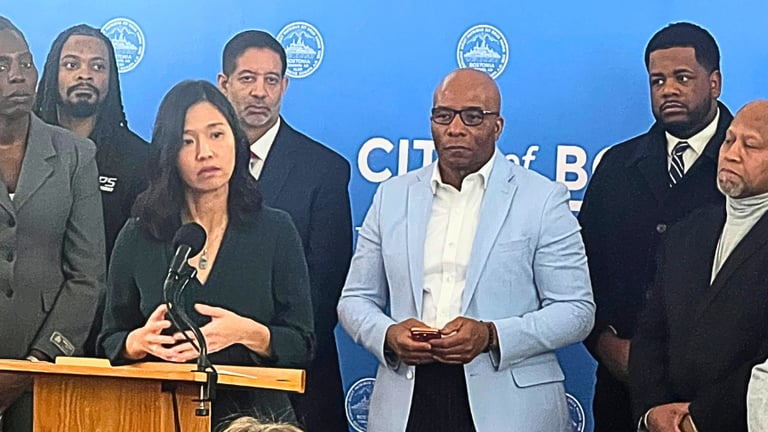
BOSTON — Reparations advocates rallied at City Hall on Wednesday demanding Mayor Michelle Wu put a $2 million minimum for the city's Reparations Task Force into next year's budget — a body that, as first reported by WBZ Newsradio, has not held a public meeting since September 20, 2025.
Eight months. No meetings. $2 million, please.
The advocates were led by Rev. Kevin Peterson of the People's Reparations Commission, who told reporters the city has so far offered nothing but words.
"We've received gestures and offers that are symbolic at best," Peterson said.
The mayor's office, asked for a response, told WBZ that Wu "is committed to reparations and is awaiting the recommendations" of the task force. The recommendations she is awaiting are from the task force that has not met since the third week of September.
The 250th anniversary
Wu has, since 2024, told reporters she hopes to begin implementing the task force's recommendations by summer 2026 — to mark the 250th anniversary of the country's founding.
In other words, the mayor's plan to commemorate America's 250th birthday is to have the City of Boston pay reparations to its Black residents.
The clock on that plan is now eight weeks from July 4. The task force she would need to deliver those recommendations has produced no public output since the autumn. And the activists who would be the program's most natural supporters are at City Hall this week telling the mayor that her existing posture — "committed" and "awaiting" — is not enough.
What's actually being asked for
"We are deeply concerned that the budget for the reparations task force will be cut in the coming fiscal year, and we ask for no less than two million dollars to be allocated to this task force," Peterson said.
MASSDAILYNEWS
STAY UPDATED
Get Mass Daily News delivered to your inbox
ADVERTISEMENT · Interested in advertising?
ADVERTISEMENT · Interested in advertising?
The $2 million floor in the FY27 budget is the modest version of the ask. Peterson's broader People's Reparations Commission has separately proposed a total $15 billion package for Boston:
- $5 billion in direct cash payments to Black Bostonians
- $5 billion drawn from financial institutions the commission accuses of historical discrimination
- $5 billion for education and anti-crime programming in Black communities
For context, $15 billion is several multiples of the entire annual operating budget of the City of Boston.
The $2 million is what Peterson's group says it would take simply to keep the existing task force functioning.
The task force itself
The Boston Reparations Task Force was created by City Council ordinance in 2022 and appointed by Mayor Wu. It is a 10-member body — chaired by Joseph D. Feaster, Jr. and including two youth members — charged with studying Boston's role in the legacy of slavery, assessing the city's actions to address it, and recommending what, if anything, the city should pay in reparations.
Its last public meeting, per the city's own posted minutes, was September 20, 2025.
It has not produced final recommendations. It has not produced an interim report on a public schedule. According to the city's own task-force page, the body is currently reviewing research reports "internally" — work the public cannot see and the activists cannot fund without the FY27 line item Peterson's group is asking for.
ADVERTISEMENT · Interested in advertising?
ADVERTISEMENT · Interested in advertising?
Peterson's argument is that the silence is the city's fault — that without a dedicated funding line, the task force cannot staff up, cannot meet, cannot deliver. The counter-argument, which Wu's office did not make on the record but which the budget itself implies, is that the FY27 cycle is already tight: the same proposed budget has, as previously reported, reduced funding for the city's LGBTQIA2S+ Advancement office and its Office for Immigrant Advancement.
A coalition crack
For a mayor whose political brand has been built on coalition-management — bike lanes, transit equity, immigrant services, LGBTQ programming, racial equity — Wednesday's rally is notable not because of who showed up, but because of who they are.
Peterson is not an opponent of Wu. The People's Reparations Commission is not aligned with the Wu opposition. They are, in the ordinary course, allies. And they spent Wednesday telling the press that the mayor's reparations posture is "symbolic at best."
The rally is the second crack in that coalition this budget cycle. The first was the pushback over reduced LGBTQIA2S+ and immigrant-office funding; the second is now reparations advocates publicly questioning whether the mayor will fund the body she herself has tied to the country's 250th anniversary.
What happens next
The Wu administration will submit its FY27 operating budget to the City Council in the coming weeks. The Council will then have the authority to amend, add, or strike line items, including any reparations task-force allocation.
The 250th anniversary is July 4, 2026.
If the mayor wants Boston's reparations recommendations to be ready by then, the task force she created will need to meet — and will need to be funded. Wednesday's rally was the activists' way of saying the clock is now too short for the city to keep responding to the question with the word "awaiting."
Loading Comments