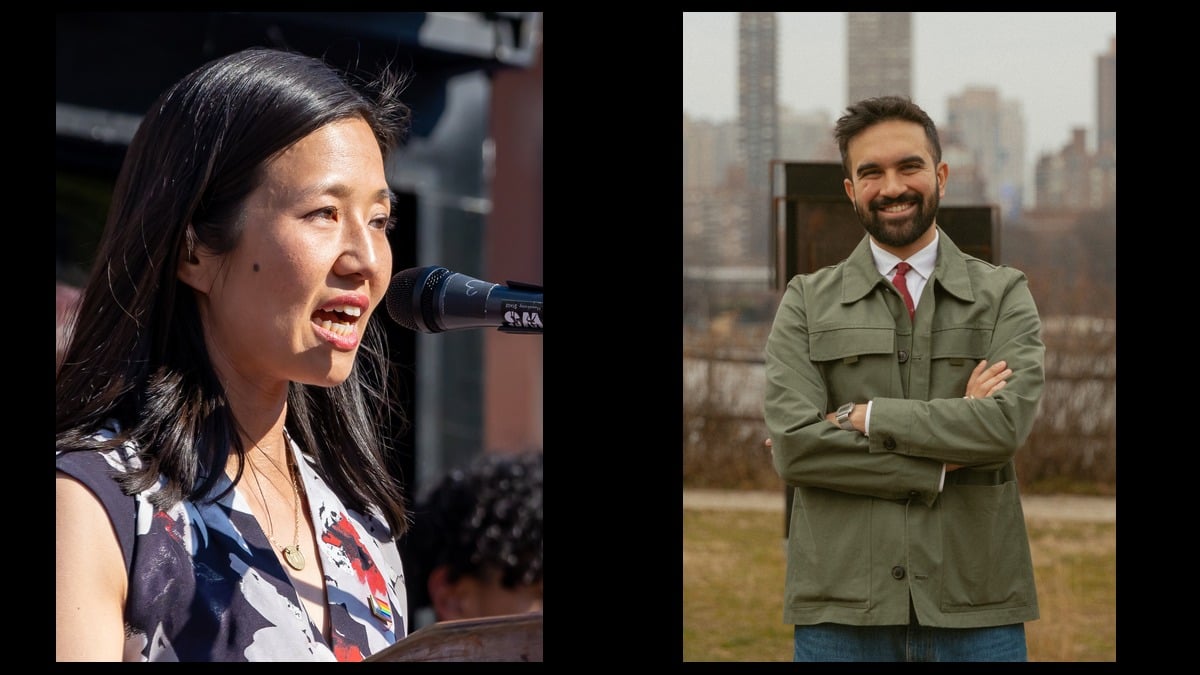
BOSTON — In Boston, Mayor Michelle Wu doubled developer fees, piled on climate mandates, and watched construction collapse 97%. In New York, Mayor Zohran Mamdani inherited a $12 billion budget hole, proposed the city's largest property tax hike in memory, and got a credit downgrade warning from Moody's — all in his first four months.
Two cities. Same progressive playbook. Same results.
Wu and Mamdani represent the sharpest edge of the Democratic Party's progressive wing — the politicians who said the old way of doing things wasn't working and that bolder, more ambitious government was the answer. Tax the rich. Mandate the green transition. Regulate development until it serves the public good. The theory was simple. The results are in.
Boston: the development pipeline is broken
Wu took office in November 2021 inheriting a construction boom built under former Mayor Marty Walsh. Developers were filing projects at a record pace. Linkage payments — the fees commercial developers pay into the city's housing fund — hit $61.4 million from projects filed in 2022.
Then Wu got to work. In 2023, she raised the inclusionary development requirement from 13% to 20% and doubled linkage fees for lab developers. She layered on Net Zero Carbon Zoning, BERDO compliance mandates, and a 218-page climate action plan that calls for eliminating fossil fuels from new construction.
The money dried up. Linkage payments from projects filed in 2025: $2.1 million. A 97% drop. Housing and commercial construction have fallen to their lowest levels in recent memory. The $91 million in one-time COVID relief that papered over the decline is gone. And the development pipeline is now broken for years to come — even if policies changed tomorrow, the projects not being filed today are the buildings that won't exist in 2030.

Boston Mayor Michelle Wu. Developer payments to the city have collapsed 97% under her watch. Photo: Joshua Qualls / Massachusetts Governor's Office.
This week, Wu went further — endorsing congestion pricing for Boston, a fee that would charge commuters to drive into the city. She pointed to Mamdani's New York as proof it works.
MASSDAILYNEWS
STAY UPDATED
Get Mass Daily News delivered to your inbox
ADVERTISEMENT · Interested in advertising?
ADVERTISEMENT · Interested in advertising?
New York: the bill comes due
Mamdani, a self-described democratic socialist and DSA member, took office on January 1, 2026 after defeating former Governor Andrew Cuomo in the Democratic primary. He campaigned on a $30 minimum wage by 2030, city-run grocery stores, fare-free buses, and universal child care.
Within weeks, he announced a $12 billion budget shortfall he blamed on the Adams administration — a figure the city comptroller largely validated but warned was actually worse than Mamdani was letting on.
His proposed solution: a $127 billion FY2027 budget — $20 billion more than the prior year — funded by a 9.5% property tax hike, new taxes on millionaires and corporations, and a drawdown of city reserves.
The response was swift. Moody's revised New York City's credit outlook from stable to negative in March, citing "sizable and persistent projected budget gaps." S&P, Fitch, and Kroll all issued warnings. The city comptroller said Mamdani's revenue projections relied on "aggressively optimistic assumptions" about Wall Street tax revenue.

NYC Mayor Zohran Mamdani. Moody's downgraded New York's credit outlook to "negative" four months into his tenure. Photo: Kara McCurdy / Wikimedia Commons / CC BY-SA 4.0.
Then came the Ken Griffin incident. On Tax Day, Mamdani filmed a video outside the Citadel CEO's $238 million penthouse to announce a new tax on luxury properties. It went viral — 52 million views. Griffin's response was to threaten canceling Citadel's planned $6 billion Midtown office project, which would have created 6,000 construction jobs and 15,000 permanent positions.
ADVERTISEMENT · Interested in advertising?
ADVERTISEMENT · Interested in advertising?
The city's budget deadline has been pushed to May 12 — the first extension since de Blasio in 2015. The gap stands at $5.4 billion by the mayor's count, $6.5 billion by the comptroller's, and potentially $10 billion within a couple of years according to the Citizens Budget Commission.
The pattern
The details are different. The pattern is the same.
Both mayors entered office promising to use government power to force outcomes the market wasn't delivering — affordable housing, climate compliance, income redistribution. Both chose regulation and taxation as the primary tools. Both assumed that developers, employers, and wealthy residents would absorb the costs and keep building, keep hiring, and keep paying.
They didn't.
In Boston, developers stopped filing projects. In New York, a billionaire threatened to pull a $6 billion investment. In both cities, the tax base that was supposed to fund the progressive agenda is shrinking.
Wu's climate plan depends on developers building expensive new green buildings. They're not building. Mamdani's budget depends on taxing the rich. The rich are threatening to leave.
It's not 2020 anymore. The era of consequence-free progressive policy is over. The money is real. The math doesn't work. And the residents of both cities are the ones left holding the bill.
Loading Comments