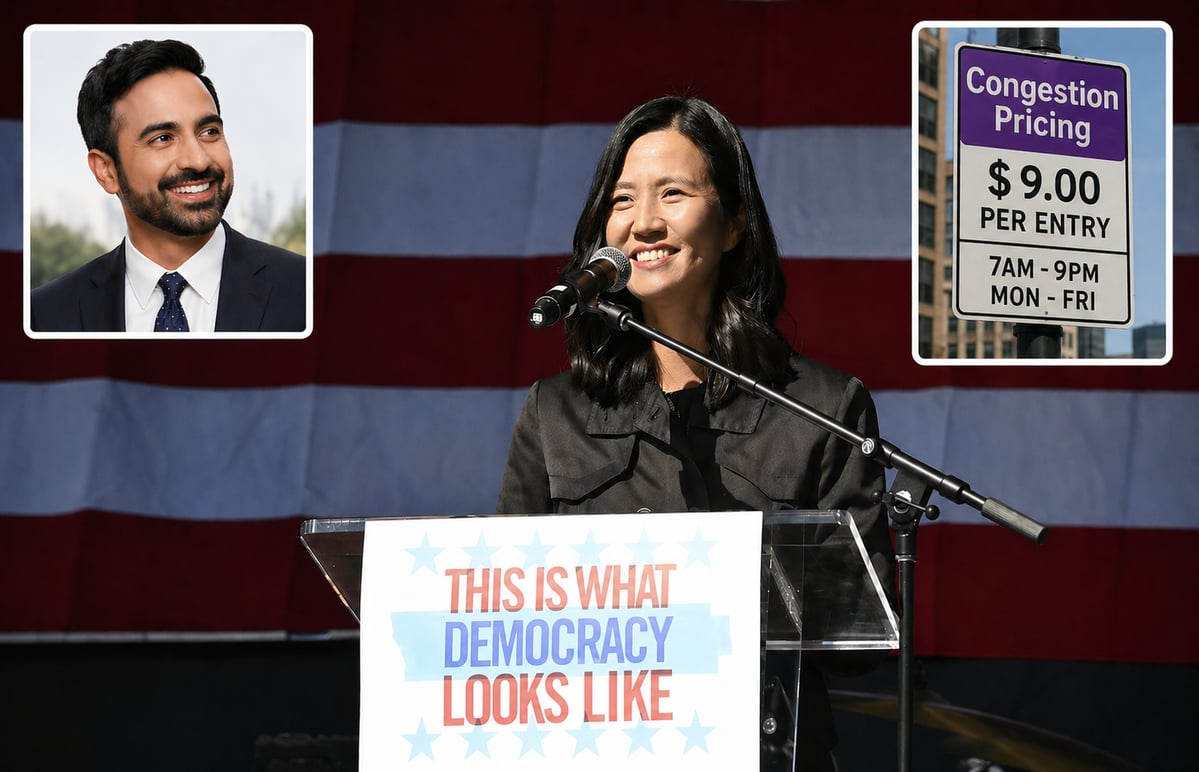
BOSTON — Mayor Michelle Wu said Tuesday that congestion pricing is a "win-win" for Boston and pointed to New York City — where the program launched last year under a plan now overseen by democratic socialist Mayor Zohran Mamdani — as proof that it works.
"I've always believed that every tool should be on the table and this is an important one," Wu said on GBH's Boston Public Radio. "We're seeing it work in New York."
The comments are Wu's most direct public endorsement of a policy that would impose a fee on drivers entering Boston, likely during peak hours. Congestion pricing was included as a strategy in the city's 218-page climate action plan, released Monday, which called for studying "parking permit fees, parking pricing structures, tolls, and congestion-related fees" to discourage driving.
Wu said a congestion charge would reduce traffic and pollution by charging higher prices at peak hours to "even out the traffic" and encourage the use of public transportation. She said the revenue could fund transit improvements.
"It can be a win-win, if we can deliver on it," Wu said. "We need to continue studying this, because if we want to get past certain ceilings on what we're doing with climate, with traffic flow, with public transportation access, there are tools that are available that could help push us through."
Healey pumps the brakes
Governor Maura Healey was less enthusiastic when asked about the idea on the same station Tuesday.
"We've got to work to keep our roads safe," Healey said. "We certainly need to reduce congestion and reduce traffic on our roads, and we need to protect our communities from climate change. Those are all three things that I believe in."
MASSDAILYNEWS
STAY UPDATED
Get Mass Daily News delivered to your inbox
ADVERTISEMENT · Interested in advertising?
ADVERTISEMENT · Interested in advertising?
Then she added the caveat: "It's also in a moment where people are already struggling with costs and affordability, so we can't be creating more problems for people. But, as I understand it, it's a study, so we'll see what comes out of it."
A policy that's been vetoed before
Congestion pricing is not a new idea in Massachusetts — and it has a track record of being killed before it starts. Former Governor Charlie Baker vetoed a bill that would have created a mobility pricing commission multiple times, including in the summer of 2022, citing equity concerns.
Healey has been warmer to the concept than Baker. Two years ago, she created a transportation funding task force that said it planned to look into mobility pricing strategies.
The New York experiment
New York City launched its congestion pricing program on January 5, 2025, charging passenger vehicles $9 to enter Manhattan south of 60th Street during peak hours. The program had been delayed for years — Governor Kathy Hochul indefinitely paused it in June 2024 before reviving it at reduced rates in November 2024.
ADVERTISEMENT · Interested in advertising?
ADVERTISEMENT · Interested in advertising?
Early results showed decreased private vehicle traffic, faster transit times, and improved air quality. The program also generated significant opposition from outer-borough residents, commuters from New Jersey, and business groups who argued the fees unfairly punished people without reliable transit alternatives.
The program is now operating under Mayor Zohran Mamdani, a democratic socialist who took office in January 2026 after defeating former Governor Andrew Cuomo in the Democratic primary.
What it would mean for Boston drivers
The climate plan doesn't specify a dollar amount for a potential Boston congestion charge, and Wu acknowledged that more study is needed. But the plan's own data underscores the scale of the target: 91% of Boston's transportation emissions come from passenger vehicles, and two-thirds of those emissions come from commuters who don't live in the city.
That means the policy would disproportionately hit suburban commuters driving into Boston for work — many of whom rely on cars because the MBTA remains unreliable.
Wu framed the charge as a way to fund transit improvements. Whether Boston commuters see it as a "win-win" or just another cost remains to be seen.
Loading Comments