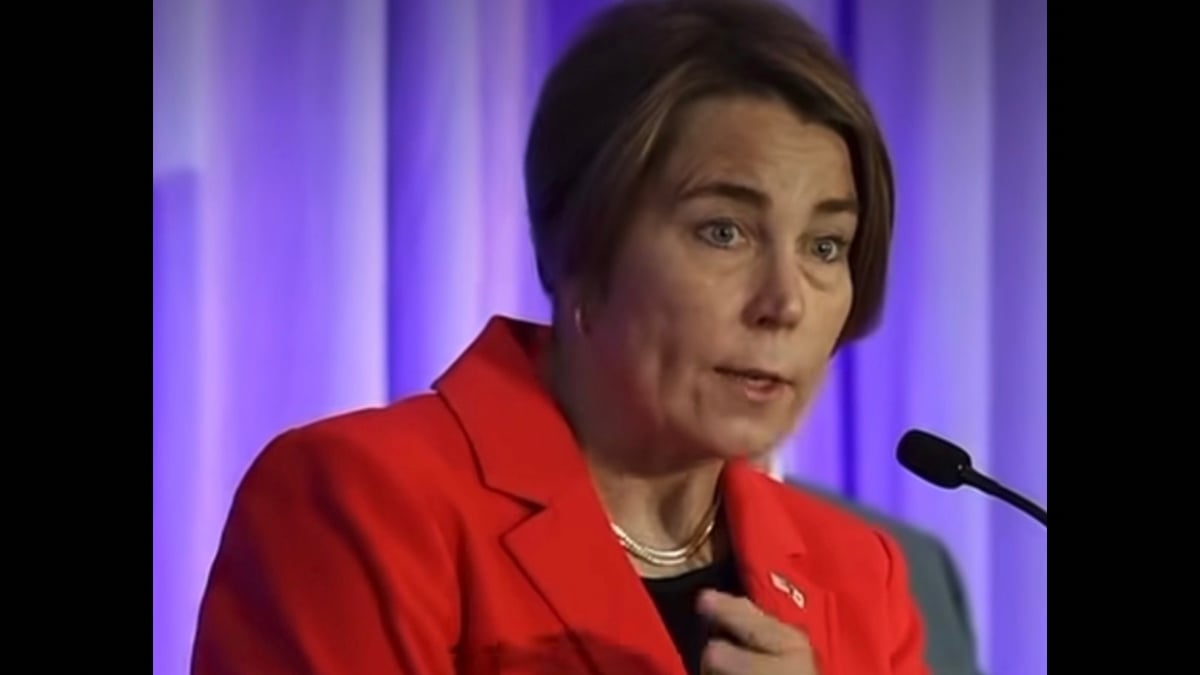
CANTON — Governor Maura Healey announced $13.4 million in funding to train heat pump installers at 13 community colleges across Massachusetts — part of the administration's push to move the state's buildings off fossil fuels and onto electric heating systems.
The announcement, made at Massasoit Community College in Canton, funds the Heat Pump Training and HVAC Network Program, which will create or upgrade training centers, expand enrollment, and prepare students for jobs installing the electric heating systems the state is increasingly requiring building owners to adopt.
Thirteen community colleges will receive funding: Berkshire, Bristol, Bunker Hill, Cape Cod, Greenfield, MassBay, Massasoit, Middlesex, Northern Essex, North Shore, Quinsigamond, Roxbury, and Springfield Technical.
Ben Downing, CEO of the Mass Clean Energy Center, said the program "brings together education, industry, and community partners to align training and workforce needs."

Governor Maura Healey. Her administration announced $13.4 million for heat pump training at 13 community colleges. Photo: Joshua Qualls / Office of the Governor.
The mandate behind the money
The timing is not a coincidence. Mayor Michelle Wu released Boston's 2030 Climate Action Plan the same week — a 218-page blueprint that calls for transitioning thousands of buildings off gas and oil heating. Under Boston's Building Emissions Reduction and Disclosure Ordinance, more than 5,000 large buildings in the city must reach net-zero emissions by 2050, with compliance deadlines already underway.
The plan also includes a pilot program to replace gas stoves with electric induction models in Dorchester public housing, a restaurant decarbonization task force studying how to transition commercial kitchens off gas, and a push to make all Boston Housing Authority units fossil fuel-free by 2030.
Someone has to install all those heat pumps. The $13.4 million is designed to produce those workers.

A residential heat pump unit. Massachusetts is spending $13.4 million to train installers as climate mandates push buildings off gas heating. Photo: WrS.tm.pl / Wikimedia Commons.
MASSDAILYNEWS
STAY UPDATED
Get Mass Daily News delivered to your inbox
ADVERTISEMENT · Interested in advertising?
ADVERTISEMENT · Interested in advertising?
The bill nobody's talking about
What the announcement didn't address is what happens after the heat pumps get installed.
Massachusetts already has among the highest residential electricity rates in the country. When temperatures drop well below freezing, some heat pump owners have reported monthly electric bills soaring to $700 or more, according to the Boston Globe, because heat pumps lose efficiency in extreme cold. A Globe reader survey found homeowners reporting winter bills double what they expected, with some houses unable to get above 60 degrees.
An American Gas Association analysis found that natural gas heating is more affordable than heat pumps in 41 out of 50 states, including all of New England — and that the average household saves $1,132 per year with gas compared to all-electric.
Only 27% of Massachusetts homes heated by natural gas would actually reduce their bills by switching to heat pumps at standard electric rates. The state had to create a special discounted rate just to make the economics work.
The grid can't handle it
The problem isn't just cost — it's capacity. ISO New England forecasts that winter peak electricity demand will surge from 20,056 MW to 26,020 MW by 2034-35, driven largely by heating electrification. By the mid-2030s, peak demand is expected to shift from summer to winter for the first time since the 1990s.
ADVERTISEMENT · Interested in advertising?
ADVERTISEMENT · Interested in advertising?
This isn't theoretical. During Winter Storm Fern in January, the U.S. Department of Energy had to issue emergency orders authorizing ISO-NE to run generators regardless of environmental permits to prevent blackouts. Total winter energy demand hit its highest level in 11 years.
And yet the state's answer is to push more buildings onto the same grid.
Even the legislature is pushing back
Heat pump installations actually declined in 2025, according to WBUR, after increases each year from 2022 to 2024. The state needs to double its annual installation rate to meet its 500,000-household target by 2030.
The Massachusetts House responded by passing an energy bill that cut roughly $1 billion from Mass Save — the primary heat pump incentive program. Environmental advocates said the cuts would "utterly devastate and probably break the program," according to Commonwealth Beacon.
Meanwhile, Governor Healey — after months of blaming utility companies for high energy costs — quietly announced a $50 credit on electricity bills and $95 million in gas bill reductions. A tacit admission, critics say, that the state's own climate policies are contributing to the problem.
A quarter of Boston households are already "energy-burdened," spending more than 6% of income on energy, according to the city's climate plan. Sixty-five percent of the city's residents are renters. Half of those are rent-burdened.
Healey is spending $13.4 million to train people to install heat pumps. The question nobody in the administration wants to answer is who's going to pay the electric bill once they do.
Loading Comments