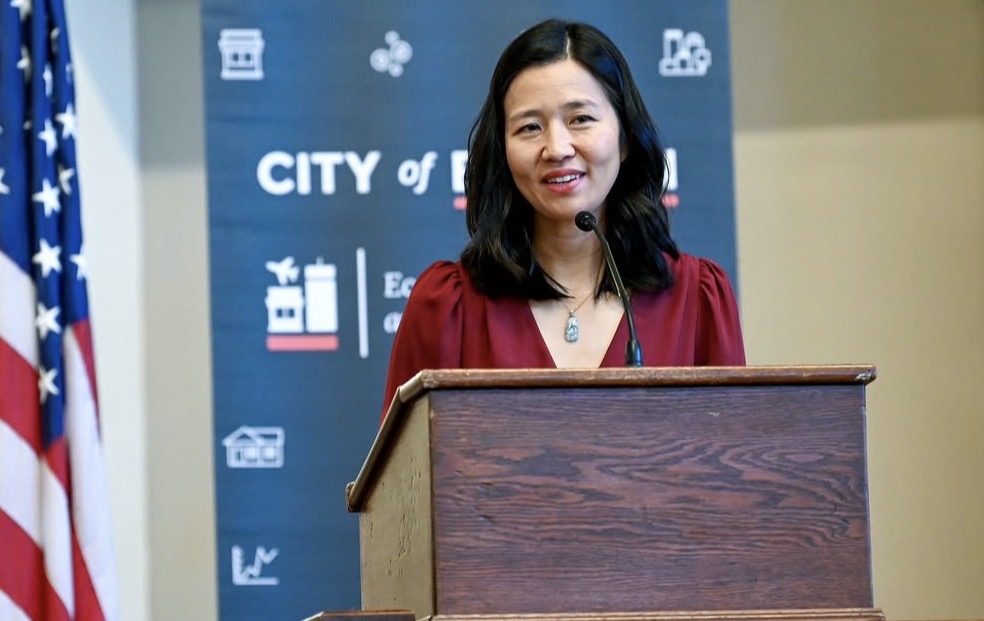
BOSTON — Mayor Michelle Wu just released a 218-page climate plan that tells Bostonians how they'll need to heat their homes, what kind of stove they can cook on, how they should get to work, and what their landlord will have to spend on building upgrades — all in the name of cutting the city's emissions in half by 2030.
What it doesn't tell them is how much any of it will cost.
The 2030 Climate Action Plan, released this month, is Boston's most ambitious climate document to date — a sweeping roadmap built on five "climate justice principles," dozens of strategies across buildings, transportation, energy, and coastal resilience, and a level of bureaucratic ambition that would be impressive if it came with a price tag.
It didn't.
208 people shaped this plan
The city ran a public survey from April to May 2025 to gather input. The number of Bostonians who responded: 208. In a city of 675,000.
Of those 208 respondents, 88% described themselves as "very concerned" about climate change — which tells you less about Boston's priorities and more about who fills out government surveys.
Neighborhood workshops followed, held in Chinatown, Dorchester, East Boston, Mattapan, Roslindale, and Roxbury. The sessions were co-hosted with community partners and focused on "climate justice." One engagement spotlight highlighted an event at the Dudley Greenhouse that drew 18 people.
This is the public mandate behind a plan that will touch every building, vehicle, and energy bill in the city.
What's in the 218 pages
The plan doesn't read like a budget proposal. It reads like a graduate thesis with a to-do list stapled to the back. Here's what it actually commits to:
Buildings — the big one. Boston has 86,000 buildings. Nearly 60% were built before 1950. The plan expands BERDO — the Building Emissions Reduction and Disclosure Ordinance — which already requires large buildings to cut emissions. Now smaller buildings are in the crosshairs. The city wants 70,000 small buildings decarbonized and weatherized, and about half of the buildings covered by BERDO will need to take action by 2030.
Buildings that can't meet emissions standards can pay "Alternative Compliance Payments" — a penalty tax that gets funneled into the Equitable Emissions Investment Fund. That fund has awarded a grand total of $1.5 million in seven grants. For context, the city budget is north of $4.5 billion.
MASSDAILYNEWS
STAY UPDATED
Get Mass Daily News delivered to your inbox
ADVERTISEMENT · Interested in advertising?
ADVERTISEMENT · Interested in advertising?
The plan also creates a "Restaurant Decarbonization Task Force" — a group that will study how to transition commercial kitchens from gas to electric. They acknowledge that restaurants "rely heavily on gas," that "high upfront costs" make the switch "especially difficult for small or tenant-operated businesses," and that restaurants have been "found to participate in the Mass Save program at much lower rates than larger businesses." The task force report is due in 2027.
And there's a $1 million pilot to replace gas stoves with electric induction in Dorchester public housing — partnered with Boston University to study the "health and cost benefits." If it works, they'll expand it citywide.
Transportation — most of the problem isn't even Boston's. Transportation accounts for a third of the city's emissions. But here's the number buried on page 118: 91% of those emissions come from passenger vehicles, and two-thirds of those emissions come from commuters who don't live in Boston. The city is building a plan to regulate emissions it doesn't generate, from people it can't govern.
The targets include a 20% EV adoption rate (up from 1% in 2022), a 50% reduction in drive-alone commuting, and a 33% increase in transit use. They want every resident within a "10-minute walk" of transit, bikeshare, and EV charging. They're studying "financial mechanisms to reduce single-occupancy vehicle commuting" — parking fees, congestion charges, tolls.
And they still want the bike lanes. The plan calls for dedicated bus lanes on Blue Hill Avenue, Tremont Street, Columbus Avenue, and Hyde Park Avenue — the same corridors Wu froze last year after voter backlash.
The city can't meet its own standards. The plan's own modeling shows that current policies only get Boston to a 48% emissions reduction — 2 points short of the 50% target. Without additional policies beyond what's already in place, they don't hit their goal. And the city's own municipal operations are even further behind: only a 36% reduction against a 60% target, with the pace of cuts "slowing and leveling off."
The municipal fleet? 462 light-duty vehicles. Only 17% fully electric. They've installed 71 Level 2 chargers and 7 fast chargers. They're mandating all future vehicle purchases be zero-emission — while telling private residents to hit 20% EV adoption in a city where most people park on the street.
The money isn't there
The plan's funding section is where the ambition meets reality.
Boston was awarded $148 million in federal climate funding through the Inflation Reduction Act and Bipartisan Infrastructure Law. As of the end of 2025, only 63% of that money has a grant agreement in place. Sixteen percent has been rescinded or stalled. Another 21% is still pending final agreement.
ADVERTISEMENT · Interested in advertising?
ADVERTISEMENT · Interested in advertising?
The coastal resilience section acknowledges the city will need "multi-billion-dollar funding" for flood protection along its 47-mile coastline. How will they pay for it? They don't know yet. A "Resilience Revenue Raising Study" is being developed with the Green Ribbon Commission and won't be released until 2027.
Meanwhile, the Equitable Emissions Investment Fund — the plan's flagship climate justice funding mechanism — has distributed $1.5 million total. Seven grants. For a city that wants to decarbonize 70,000 buildings.
25% energy-burdened, 65% renters
The plan acknowledges on page 47 that a quarter of Boston households are already "energy-burdened" — spending more than 6% of their income on energy. Sixty-five percent of residents are renters. Half of those renters are "rent-burdened," paying more than 30% of their income in rent.
The plan also acknowledges that "renters face additional and compounding challenges" and that "current policies assume homeowners, leaving renters out of most solutions." Their own community feedback found that building owners getting retrofit money must commit to maintaining affordable rents for ten years — meaning climate mandates come with rent control strings attached.
And then there are the 20,000 basement apartments the plan identifies as vulnerable to flooding — 28% of them inside the Coastal Flood Resilience Overlay District. The plan's response: a pilot program in Dorchester in 2026.
What it amounts to
The 2030 Climate Action Plan is a 218-page document with five justice principles, a "Climate Justice Index" that won't be ready until 2027, a revenue study that won't be done until 2027, a restaurant task force report due in 2027, and a stove replacement pilot that might expand citywide if the results look good.
It was shaped by 208 survey responses. It targets buildings, cars, stoves, and landlords. It can't hit its own targets with current policies. The federal money it was counting on is being pulled back. And the city's own buildings aren't in compliance with the standards it wants to impose on everyone else.
The plan says "climate action is not always positive" and that "climate programs can also produce benefits and burdens that are not equitably distributed." That's the most honest sentence in all 218 pages.
Loading Comments