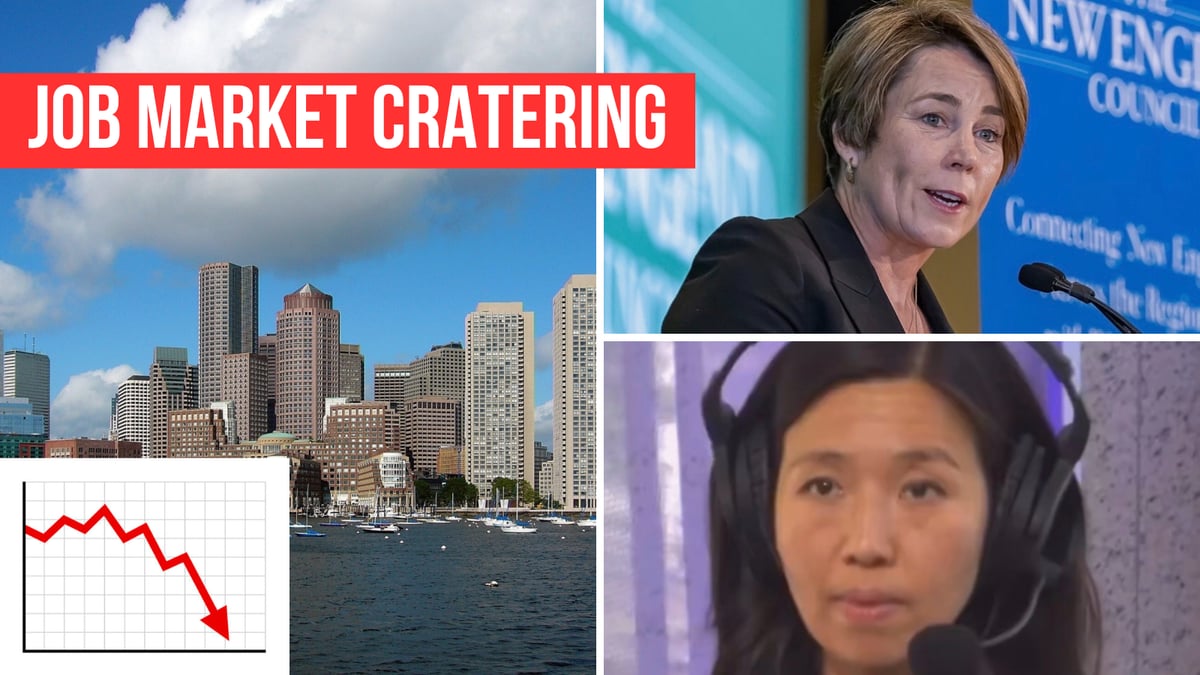
BOSTON — A respected Tufts policy director dropped four quiet words into the timeline on Wednesday that tell Massachusetts's real 2026 economic story.
"Not great for Boston..."
Attached: a Bureau of Labor Statistics chart tracking 12-month nonfarm employment changes across America's metro areas. Boston-Cambridge-Newton lands near the very bottom — second-worst in the entire country. The only metro losing more jobs than Boston is Washington DC, where the losses are deliberate. The Trump administration has been openly trimming federal headcount, cutting positions the White House considers unneeded bureaucracy.
Boston cannot say the same. Nobody planned these Boston job losses. Nobody is rooting out waste at State Street or in Kendall Square. The work is just leaving — or never showing up here in the first place.
not great for Boston... pic.twitter.com/xpT08RCbyO— Evan Horowitz (@cSPAHorowitz) April 22, 2026
The man posting the chart is Evan Horowitz, Executive Director of the Center for State Policy Analysis at Tufts University's Tisch College and a former "Quick Study" data columnist for the Boston Globe. His shop is nonpartisan. He is the person local press call for a sanity check on numbers — not a political operative, not a Healey critic, not a Wu critic. When Horowitz says "not great," take it at face value.
What the chart actually shows
The BLS tracks 12-month nonfarm employment changes across America's metro areas and flags only the moves that are statistically significant — meaning, not noise. Very few big-city metros made the losers' list at all.
Two did:
- Washington-Arlington-Alexandria, DC-VA-MD-WV — the biggest loser on the chart
- Boston-Cambridge-Newton, MA-NH — second place
DC's story is straightforward, and, depending on your politics, a feature rather than a bug. The Trump administration has been shrinking federal payrolls on purpose, reducing positions the White House has identified as excess. Those are jobs being cut by design — a stated goal of the administration, not an accident.
MASSDAILYNEWS
STAY UPDATED
Get Mass Daily News delivered to your inbox
ADVERTISEMENT · Interested in advertising?
ADVERTISEMENT · Interested in advertising?
Boston's story is the opposite. Nobody is deliberately trimming Boston's payrolls. These are private-sector jobs that simply are not getting filled, are getting eliminated, or are quietly migrating to states that make it easier to hire, build and expand.
At the top of the chart, the metros hiring Americans fastest are in Arkansas, North Carolina, California, Missouri, New Jersey and Arizona. The jobs are moving. They are just not moving here.
The kitchen-table translation
Strip the jargon away and here is what a statistically significant 12-month employment loss means for a Massachusetts family.
Fewer open jobs. Slower raises when you ask for one. A harder time when your kid shows up back home with a fresh degree and a résumé. More moving trucks headed south and west. A rental market where the only people bidding are the ones who haven't left yet.
And less state tax revenue to fund the services Beacon Hill keeps promising — which means, as night follows day, the households that stay are going to be asked to make up the difference for the households that left. Less income tax collected. Fewer payroll taxes. Smaller sales-tax receipts. The math only ends one way, and it does not end with Beacon Hill spending less.
This is the number that shows up in your paycheck before it shows up in a press release.
The mayor's message to business
For an answer to the obvious question — why would a company hire in Boston right now — it helps to remember what Mayor Michelle Wu has spent the last two years telling the city's employers.
ADVERTISEMENT · Interested in advertising?
ADVERTISEMENT · Interested in advertising?
Wu spent 2024 and 2025 lobbying the State House for special authority to shift Boston's property tax burden onto commercial property owners. The State Senate rejected the plan 33–5 in a public roll-call vote — a blowout by any definition. Only five senators backed her. Thirty-three did not.
Her response was not to regroup. She used the MLK Day breakfast to call the defeat "devastating" and to publicly shout out the handful of senators who had voted her way. Weeks later she skipped the St. Patrick's Day breakfast — an event she had attended every year since winning office in 2021 — rather than share a room with the Boston senator who led the opposition to her plan.
The specific battle was technical. The message employers took away from it was not. For two straight years, the clearest signal from Boston City Hall to the people who sign the checks has been: when times get tight, we come to you.
Now the BLS chart is out. Boston is second-worst in the country for jobs. Companies can read the news.
Beacon Hill's silence
Governor Maura Healey has not publicly addressed the BLS chart. Mayor Michelle Wu has not publicly addressed the BLS chart. The state's economic development apparatus — which exists in theory to track exactly this sort of thing — has not, either.
It took a nonpartisan researcher at Tufts to put the data in front of people.
Four words. One chart. The Massachusetts economic story of 2026 compressed into a single tweet from a man who does not overstate things.
Not great for Boston.
Loading Comments