BOSTON — A Florida man walked into a Fall River bank last summer, handed the teller a note that said "I have a bomb," and walked out with $5,000. He got caught the same day with dye on his hands and stolen cash in his pocket. Open and shut.
But before his case was resolved, a legal question made it all the way to the state's highest court: could prosecutors hold him without bail as a danger to the public?
The Supreme Judicial Court said no. Armed robbery, the justices ruled on March 10, doesn't count as a violent enough crime to lock someone up before trial.
Read that again. Armed robbery. Not violent enough.
The bank job
Domingo Agostini, 41, of Port St. Lucie, Florida, walked into the Rockland Trust on Brayton Avenue in Fall River on August 18 and handed a teller a note scrawled on a paper bag: "I have a bomb." He demanded $20,000. The teller gave him about $5,000 — with a red dye pack tucked inside.
The pack exploded on his way out. Surveillance cameras caught him fleeing in a black Nissan Rogue with Florida plates. Providence police pulled him over before 2 p.m. — same clothes, red dye all over his hands, stolen money still on him.
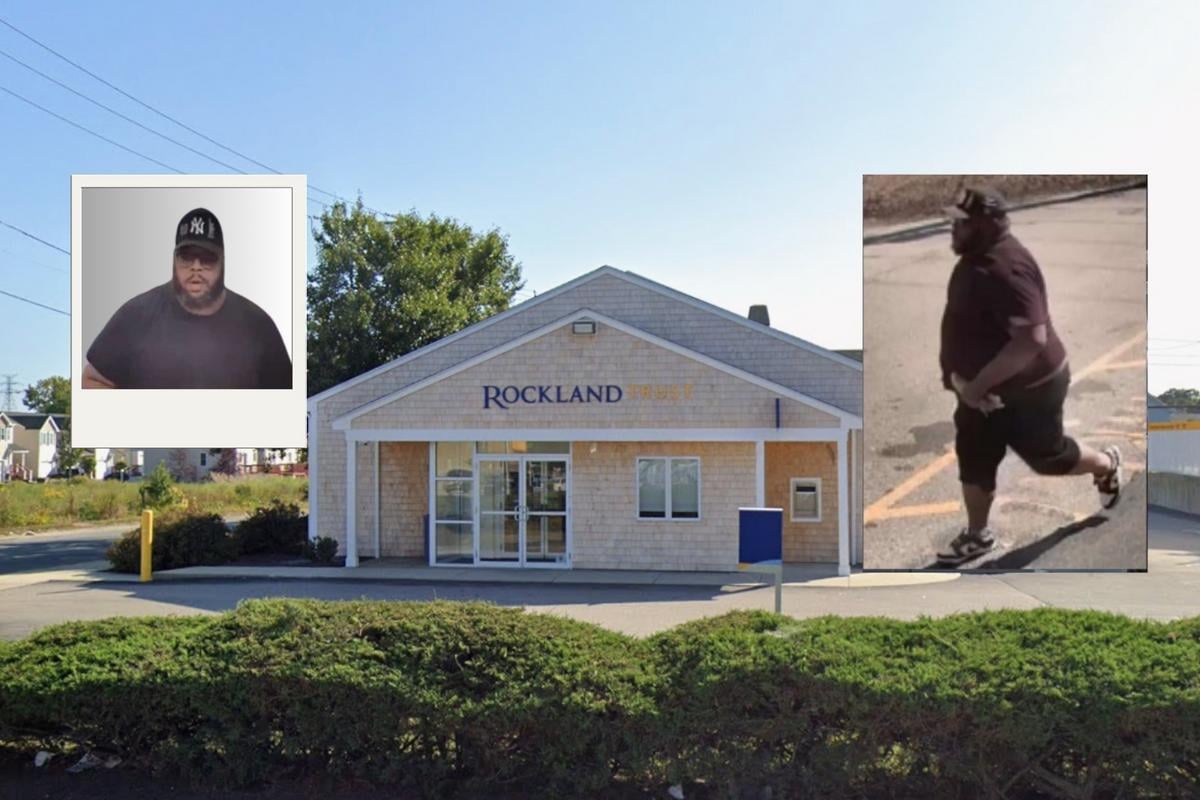
Domingo Agostini (left), surveillance footage of the suspect fleeing (right), and the Rockland Trust bank in Fall River he allegedly robbed with a bomb threat. (WBSM / Fall River Police)
He pleaded guilty in Fall River Superior Court on January 8 to armed robbery and making a bomb threat. Bristol County DA Thomas Quinn got him two to four years.
The ruling nobody talked about
Here's where it gets bad.
MASSDAILYNEWS
STAY UPDATED
Get Mass Daily News delivered to your inbox
ADVERTISEMENT · Interested in advertising?
ADVERTISEMENT · Interested in advertising?
Under Massachusetts law, there's a tool called Section 58A that lets prosecutors ask a judge to hold someone for up to 120 days with no bail at all — no ankle monitor, no conditions, just locked up. It's the strongest card a DA can play to keep a dangerous person off the street before trial.
The SJC just took that card away for armed robbery.
The court's reasoning: armed robbery doesn't always involve physical force. Some armed robberies are just a note on a paper bag. So the crime doesn't automatically qualify under the part of the law that requires violence. The legal term is "minimal force." The street translation is: rob a bank, walk out of court the same day.
The SJC didn’t leave room for interpretation. From the ruling:
“We accordingly hold that armed robbery, G. L. c. 265, § 17, does not categorically contain an element of physical force or qualify as a predicate offense under G. L. c. 276, § 58A.”
That applies to all armed robbery — not just bomb threat cases. The court used a “categorical approach,” looking at the crime’s legal definition rather than the facts of any one case. Because armed robbery can be committed with minimal physical contact, the entire category is out. The justices even addressed the weapon, writing that there is a “material difference between the presence of a weapon, which produces a risk of violent force, and the actual or threatened use of such force.” Having a gun during a robbery isn’t enough. You have to use it.
It's not just armed robbery
This isn't a one-off. The SJC has been gutting 58A for years.
In 2022, they ruled that manslaughter and assault with a dangerous weapon don't qualify either — as long as the crime could have been committed recklessly. A drunk driver who kills someone? Can't be held as dangerous. That was Commonwealth v. Escobar.
ADVERTISEMENT · Interested in advertising?
ADVERTISEMENT · Interested in advertising?
In 2019, they ruled that statutory rape and indecent assault on a child don't qualify. Same decision, the justices threw out the entire catch-all provision of the law that gave prosecutors wiggle room in tough cases. Called it "unconstitutionally vague." Gone.
Now armed robbery is off the list too. The law that was written in 1994 to keep violent criminals locked up before trial has been carved down to almost nothing.
What this means for you
The next person who robs a bank in Massachusetts — bomb threat, knife, gun, doesn't matter — cannot be held as dangerous. A judge can set bail, sure. But the tool that was designed to keep the worst offenders behind bars until trial? It doesn't apply anymore.
The pattern is everywhere. A career criminal with 47 prior charges was out on $0 bail for four separate felonies when he carjacked a woman and was shot by a Boston police officer. A 77-year-old man was beaten over a misdelivered package by a career criminal who was already out on bail. This ruling is part of the reason why.
The SJC handed down this ruling on March 10. No press conference. No politician said a word. The court quietly made it harder to keep violent criminals locked up, and moved on.
The people living with the consequences didn't get a heads up.
Loading Comments