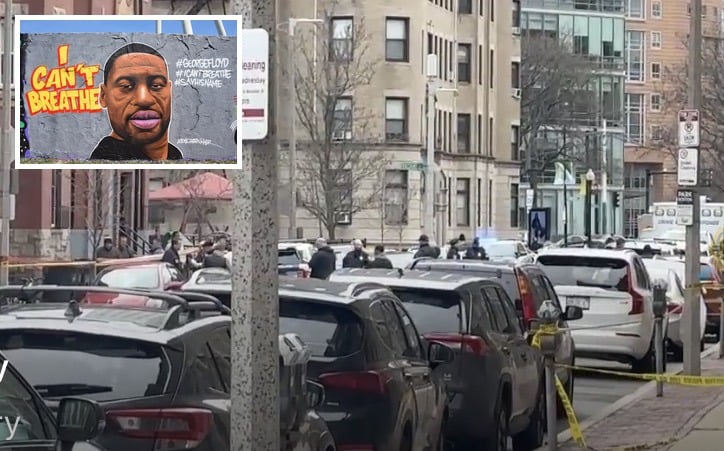
BOSTON — In the summer of 2020, after the death of George Floyd and the protests that followed, the far left decided cops were the problem. Their theory? Armed officers escalate mental health crises. Send social workers and clinicians instead, and people would stop getting hurt. On Saturday in Boston, one of those clinicians was attacked with a sword.
The clinician was knocked to the ground inside an apartment building on Hemenway Street, steps from Northeastern University's campus. A police officer was stabbed in the arm. The man who attacked them, apparently in the grip of paranoid delusions, was shot by other officers and later died at a hospital. He had spent close to 45 minutes talking to the clinician through his locked door before he opened it.
The clinician did everything the activists said would work. It didn't.
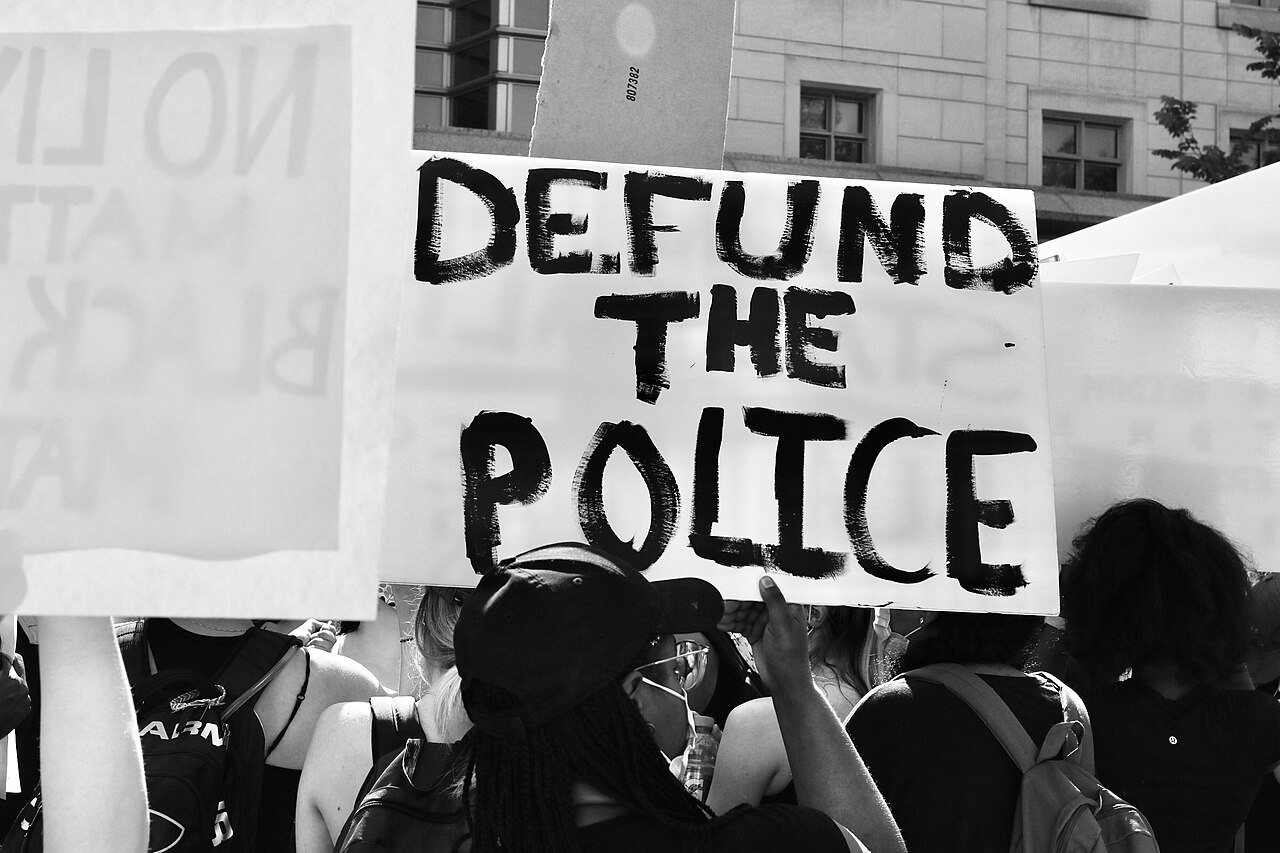
The movement to replace police with social workers on mental health calls exploded after George Floyd's death in 2020. (Wikimedia Commons)
What happened on Hemenway Street
The suspect, who has not been publicly identified, had called 911 that morning claiming four armed people were coming to kill him, a threat that didn't exist. Officers arrived at 212 Hemenway Street and found nobody in the hallway. Just a locked door and a man behind it.
They called in a worker from Boston's BEST program, a co-responder model where master's-level mental health professionals ride alongside officers to de-escalate crisis calls. This isn't some half-baked experiment. The program has been running since 2011, nine years before George Floyd, and handled 4,230 encounters in 2023 alone with twelve clinicians working the streets seven days a week.
The clinician talked to the man through the door for the better part of an hour. Then he opened it and attacked, striking both the clinician and an officer with what Police Commissioner Michael Cox described as "some sort of sword." Officers fired a Taser and their weapons. The man was rushed to a hospital and pronounced dead. Several other officers and two EMS workers were also hospitalized with non-life-threatening injuries.
The movement behind the model

Protesters rally at Nubian Square in Boston during the George Floyd protests of 2020. (Wikimedia Commons)
After George Floyd's death, cities across the country scrambled to build alternatives to police response. The poster child was CAHOOTS in Eugene, Oregon, a program that has sent two-person crisis teams to low-risk calls since 1989. Denver launched STAR. New York rolled out B-HEARD. Activists who had never set foot in a patrol car were suddenly writing the playbook for crisis intervention, and city councils were happy to hand them the money.
What those activists rarely mentioned is that CAHOOTS doesn't take calls involving weapons, violence, or anything remotely dangerous. Out of 24,000 calls in 2019, their teams requested police backup just 311 times. In other words, the program works because it only shows up when there's no real danger. The man on Hemenway Street had a sword. CAHOOTS would never have taken that call. But the activists who held CAHOOTS up as the model didn't build in that distinction, and city councils didn't ask.
MASSDAILYNEWS
STAY UPDATED
Get Mass Daily News delivered to your inbox
ADVERTISEMENT · Interested in advertising?
ADVERTISEMENT · Interested in advertising?
Wu's Boston

Boston Mayor Michelle Wu campaigned on diverting 911 mental health calls away from police. (Capt. Kevin M. Lindow / U.S. Army)
Mayor Michelle Wu made the philosophy her own. Her campaign platform called for diverting 911 mental health calls away from police, and she committed $21 million over five years to behavioral health programs after taking office. Acting Mayor Kim Janey had already launched a pilot to shift those calls away from law enforcement in 2021. Wu picked up the baton and ran with it.
The Hemenway Street clinician isn't the first person to get hurt following this playbook. In November 2020, housing case manager Kristin Benson was stabbed to death by a client in Seattle. Days later, behavioral health worker Travis Knight was shot dead outside a treatment facility in Melbourne, Florida, by a former patient who came back specifically to murder him. The promise, repeated endlessly by activists and politicians who would never be the ones knocking on that door, was that de-escalation would keep everyone safe.
The cops who are afraid to act
Within hours of Saturday's attack, the Boston Police Patrolmen's Association made clear who they blame.
'The overzealous DA should take a bow now that cops are waiting to get stabbed before taking steps to protect themselves,' the BPPA wrote.
That DA is Kevin Hayden, who just over two weeks earlier, on March 19, sent officers to arrest Nicholas O'Malley at his home. Not at the station. At his front door. O'Malley is a 33-year-old cop with a wife, a toddler, and a six-month-old baby. His attorney said he wasn't allowed to turn himself in. The charge was manslaughter — for shooting a carjacker who had rammed a police cruiser and had 47 prior charges. Hayden said it wasn't self-defense. The message to every cop in the city was unmistakable: act, and we'll come for you.
It was the first time in roughly 35 years, since 1991, that a Boston cop had been charged with manslaughter for an on-duty shooting. Wu publicly thanked Hayden for the prosecution.
ADVERTISEMENT · Interested in advertising?
ADVERTISEMENT · Interested in advertising?
Sixteen days later, those same officers stood outside a door and talked for 45 minutes while the man on the other side decided when the conversation was over.
The movement wants a seat at the State House
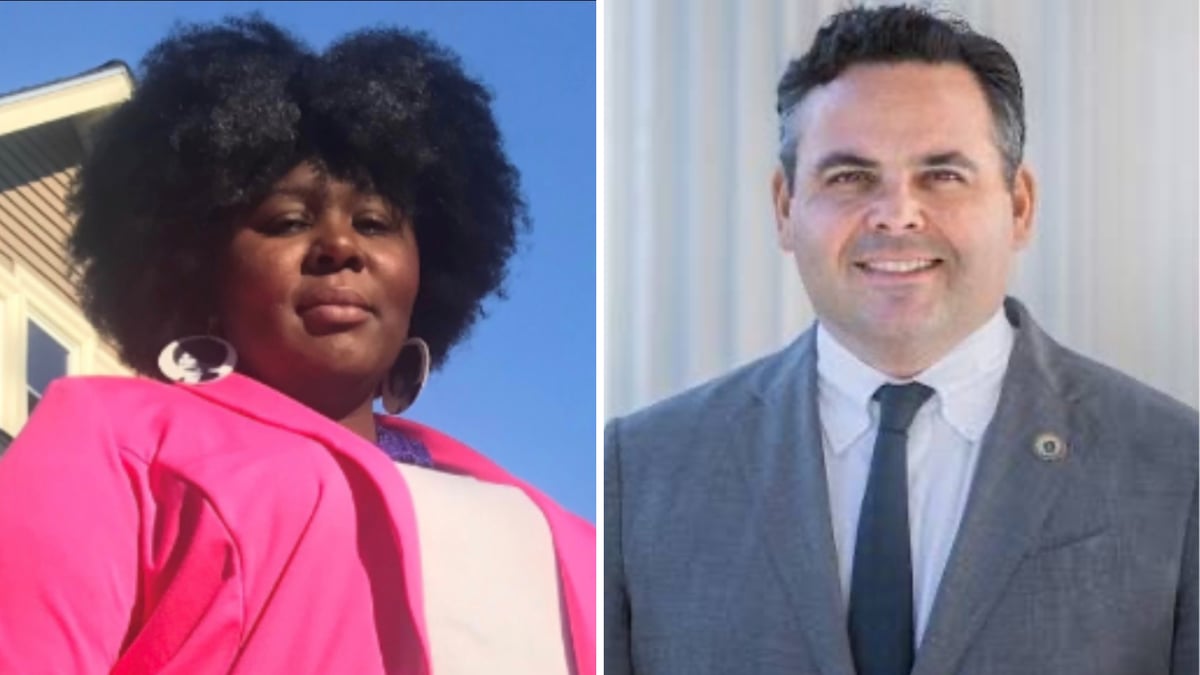
Latoya Gayle (left), who organized a George Floyd march in Boston, is challenging popular Democratic state Sen. Nick Collins (right) in the 1st Suffolk primary. (Gayle photo: GBH; Collins: official portrait)
Meanwhile, one of the activists who marched under the George Floyd banner in Boston is now running for state senate. Latoya Gayle, who co-founded "March Like a Mother for Black Lives" in the summer of 2020, is challenging popular Democratic incumbent Nick Collins in the 1st Suffolk District primary this September.
Collins made enemies in Wu's circle by doing what most voters would consider his job. He blocked Wu's plan to jack up taxes on struggling businesses as her spending ballooned and showed no signs of slowing, and called her out for withholding tax data from lawmakers. That's apparently enough to earn a primary challenger. Gayle has been seen with Wu at political events and has openly cited Collins' opposition to Wu's tax hike as her reason for running.
The same far-left ideology that put an unarmed clinician at a stranger's door on Saturday morning now wants a seat at the State House.
The silence
Wu has not commented on Saturday's attack. Hayden has not responded to the union. Northeastern's police chief already assured everyone there's nothing to worry about. The activists who wrote the playbook are nowhere to be found.
Not one of them was on Hemenway Street on Saturday morning.
Loading Comments