
BOSTON — Two Venezuelan nationals who were in the United States illegally have been charged after allegedly draining ATMs across five New England states using malware — and federal prosecutors say half of everything they stole was wired straight back to gang leadership in Venezuela.
Moises Alejandro Martinez Gutierrez and Lestter Guerrero, both 29, are alleged members of Tren de Aragua, one of the most violent transnational criminal organizations in the Western Hemisphere. They've been charged with conspiracy to commit bank theft after a weeks-long spree that saw ATMs from Braintree to Maine forced to spit out every last dollar on command.
🚨#BREAKING: #FBI Boston's Violent Crimes Task Force has charged two Venezuelan nationals & alleged Tren De Aragua gang members, Moises Alejandro Martinez Gutierrez & Lestter Guerrero, in connection with an ATM jackpotting conspiracy that included robberies & attempted robberies… pic.twitter.com/RTIasxZ4LV— FBI Boston (@FBIBoston) February 26, 2026
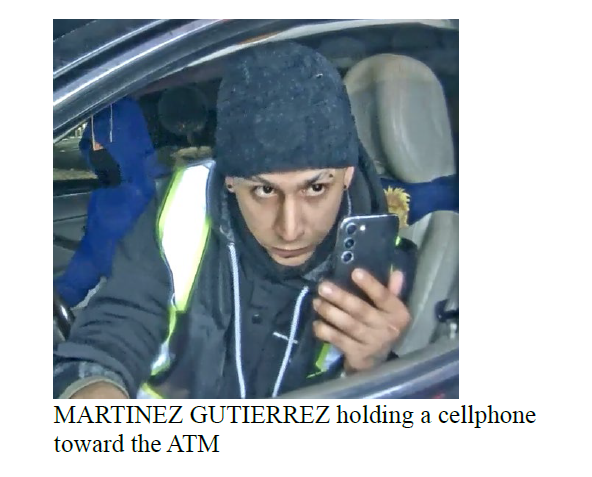
ATM surveillance footage shows Martinez Gutierrez holding a cellphone toward the machine during an alleged jackpotting attempt. (DOJ)
The technique is called "jackpotting" — and it's exactly what it sounds like. The pair allegedly walked up to ATMs, installed malware directly into the machines' software, and made them vomit out their entire cash supply like a rigged slot machine. The whole thing took minutes.
And they did it over and over again.
Five states. 36 days. One spree.
According to federal prosecutors, Martinez Gutierrez is connected to at least six ATM jackpotting incidents across New England in a little over a month:
- Dec. 31, 2025 — Norwich, Conn. (successful robbery)
- Jan. 14, 2026 — Coventry, R.I. (attempted)
- Jan. 19, 2026 — Stoneham, Mass. (attempted)
- Jan. 20, 2026 — Braintree, Mass. (successful robbery)
- Jan. 30, 2026 — Rochester, N.H. (successful robbery)
- Feb. 5, 2026 — Augusta, Maine (attempted — where they were finally caught)
Guerrero is tied to at least one additional robbery alongside Martinez Gutierrez in Rochester on Jan. 30.
MASSDAILYNEWS
STAY UPDATED
Get Mass Daily News delivered to your inbox
ADVERTISEMENT · Interested in advertising?
ADVERTISEMENT · Interested in advertising?
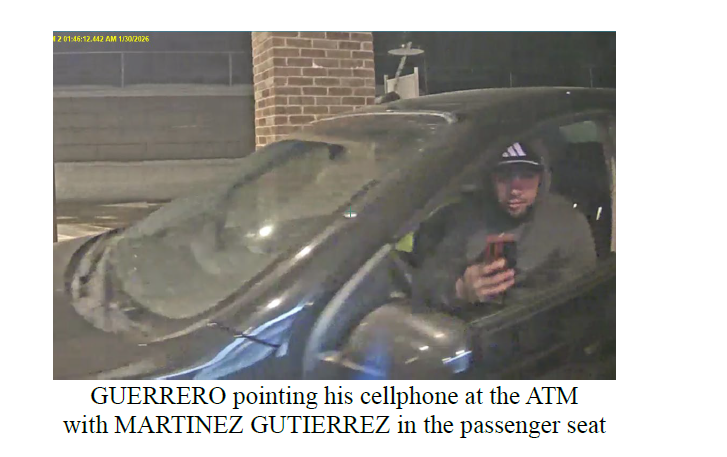
Guerrero, wearing an Adidas cap, points his cellphone at the ATM while Martinez Gutierrez sits in the passenger seat during another alleged robbery. (DOJ)
Half the money went to Venezuela
Here's where it gets worse.
According to court filings, TdA's jackpotting operation follows a strict revenue split: 50% of stolen proceeds get wired back to gang leadership in Venezuela. The other 50% is divided among the ground crew actually breaking into the machines.
It's not petty theft — it's a pipeline. American ATMs funding a Venezuelan criminal empire.
Just two of 87
Martinez Gutierrez and Guerrero aren't outliers. They're part of what has become one of the largest ATM fraud prosecutions in American history.
ADVERTISEMENT · Interested in advertising?
ADVERTISEMENT · Interested in advertising?
A separate federal indictment out of the District of Nebraska — where the broader investigation is centered — has now charged 87 defendants in the nationwide jackpotting conspiracy. The Massachusetts case represents just one tentacle of an operation that has hit ATMs from coast to coast.
What is Tren de Aragua?
Tren de Aragua — roughly "Aragua Train" — started in a Venezuelan prison in the mid-2000s and has since spread across the Western Hemisphere. Federal law enforcement considers it one of the most dangerous criminal organizations currently operating on American soil.
The group's rap sheet includes human smuggling, drug trafficking, extortion, kidnapping and robbery. The ATM jackpotting charges represent an unusual pivot into cybercrime for an organization more commonly associated with street-level violence — and it suggests TdA is getting more sophisticated, not less.
TdA is hardly the only gang making headlines in Massachusetts. Just this week, ICE Boston arrested a Nortenos gang member who had been deported three times and was hiding in the state with assault, carjacking and terrorizing charges across three states. Meanwhile, a 25-year-old Lynn man pleaded guilty to racketeering involving brutal murders as part of a separate gang violence prosecution — and the Boston City Council voted 9-4 to block the public from learning whether ignored ICE detainers involved actual criminals.
The conspiracy charge carries up to five years in prison, three years of supervised release and a $250,000 fine.
The case was announced by US Attorney Leah B. Foley and FBI Special Agent in Charge Ted E. Docks, and is being prosecuted by AUSA Kaitlin J. Brown and Peter K. Levitt, Chief of the Organized Crime & Gang Unit.
The defendants are presumed innocent unless and until proven guilty beyond a reasonable doubt in a court of law.
Loading Comments