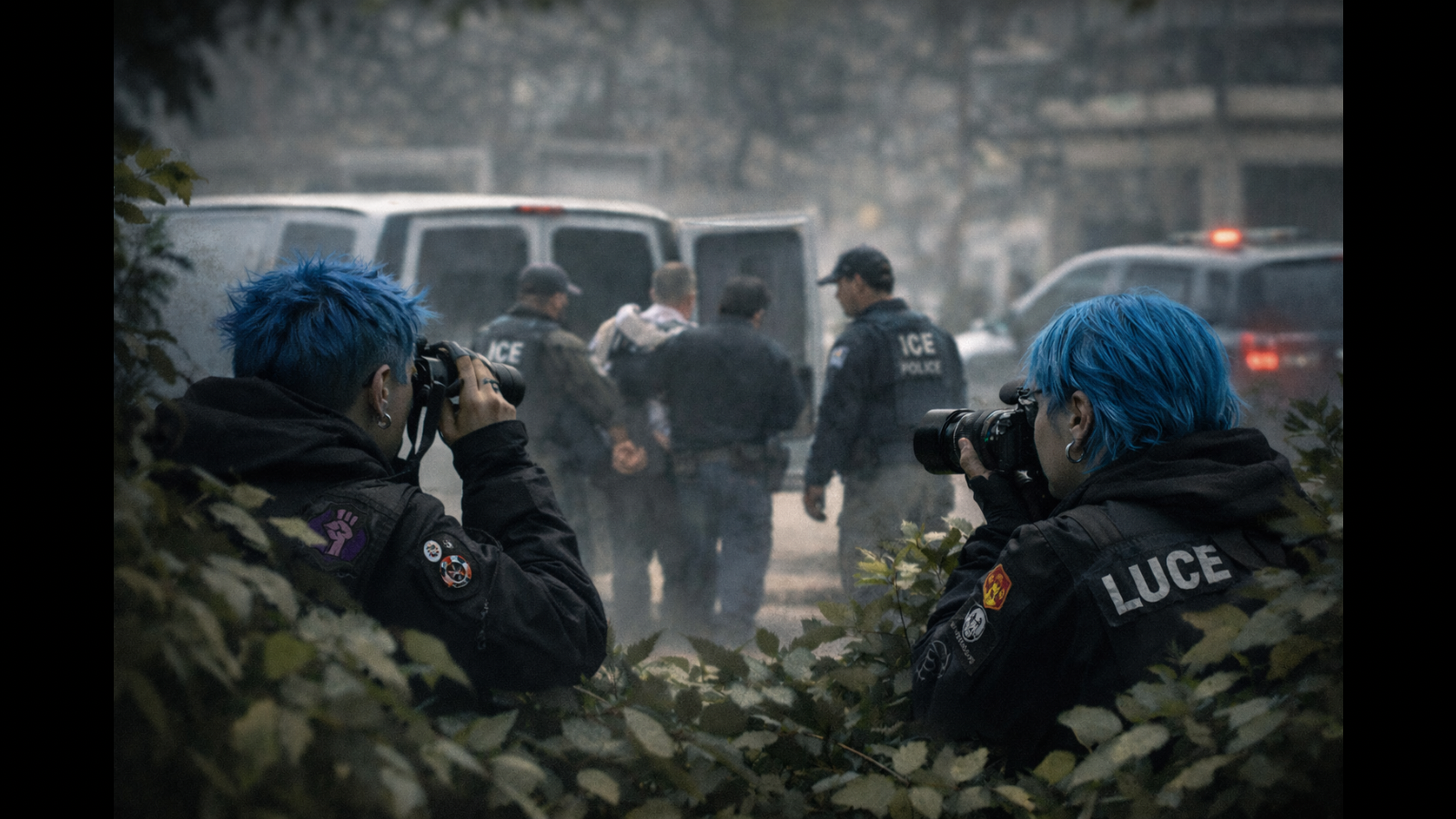
BOSTON — While federal immigration agents crisscross Massachusetts carrying out court-authorized arrests, a growing network of self-described “ICE watchers” has taken to the shadows — sometimes literally — to track their movements.
WBUR reports that volunteers connected to the LUCE Immigrant Justice Network of Massachusetts have been monitoring Immigration and Customs Enforcement activity across the state, dispatching observers to neighborhoods, courthouses, and streets where agents are spotted. The group says its goal is to document arrests and provide what it calls community oversight of federal immigration enforcement.
In practice, the effort often looks less like transparency and more like amateur surveillance. Activists trail unmarked vehicles, crouch with cameras, and push real-time updates to social media whenever ICE agents move in. Federal officials say the agents are simply doing their jobs: enforcing immigration law under the authority of the Department of Homeland Security.
MASSDAILYNEWS
STAY UPDATED
Get Mass Daily News delivered to your inbox
ADVERTISEMENT · Interested in advertising?
ADVERTISEMENT · Interested in advertising?
ICE stepped up operations in Massachusetts last year as part of a broader enforcement push, citing repeated immigration violations and, in many cases, criminal histories among those arrested. In September alone, authorities reported more than 1,400 arrests statewide, describing the operation as a public-safety necessity in a state where local police are largely barred from cooperating on civil immigration detainers.
That tension has played out in Boston-area courthouses, where ICE agents have made arrests after local jurisdictions declined to hold suspects for federal pickup. In one case highlighted by WBUR, activists challenged court staff and questioned the legality of an arrest — even though federal law allows ICE to act independently of state and local governments.
The activists have intensified their efforts following national outrage over a deadly ICE shooting in Minnesota, an incident unrelated to Massachusetts enforcement but frequently cited by organizers as justification for increased monitoring. LUCE volunteers insist they do not interfere with arrests, telling WBUR they keep their distance and focus only on observation.
ADVERTISEMENT · Interested in advertising?
ADVERTISEMENT · Interested in advertising?
Federal officials have warned that line can be thin. U.S. Attorney Leah Foley has cautioned that obstructing or impeding federal agents is a crime, regardless of political motivation, a reminder that “watching” can quickly turn into something more serious.
Supporters of immigration enforcement say the spectacle misses the point. ICE agents are executing lawful orders in a state whose sanctuary-style policies leave federal authorities to act alone. Critics argue the arrests sow fear, but enforcement advocates counter that policy fights belong in legislatures and courts — not on sidewalks with cameras.
As Massachusetts continues to debate its approach to immigration enforcement, one reality remains unchanged: ICE is carrying out the law, and a small but vocal group is determined to follow every step.
Loading Comments