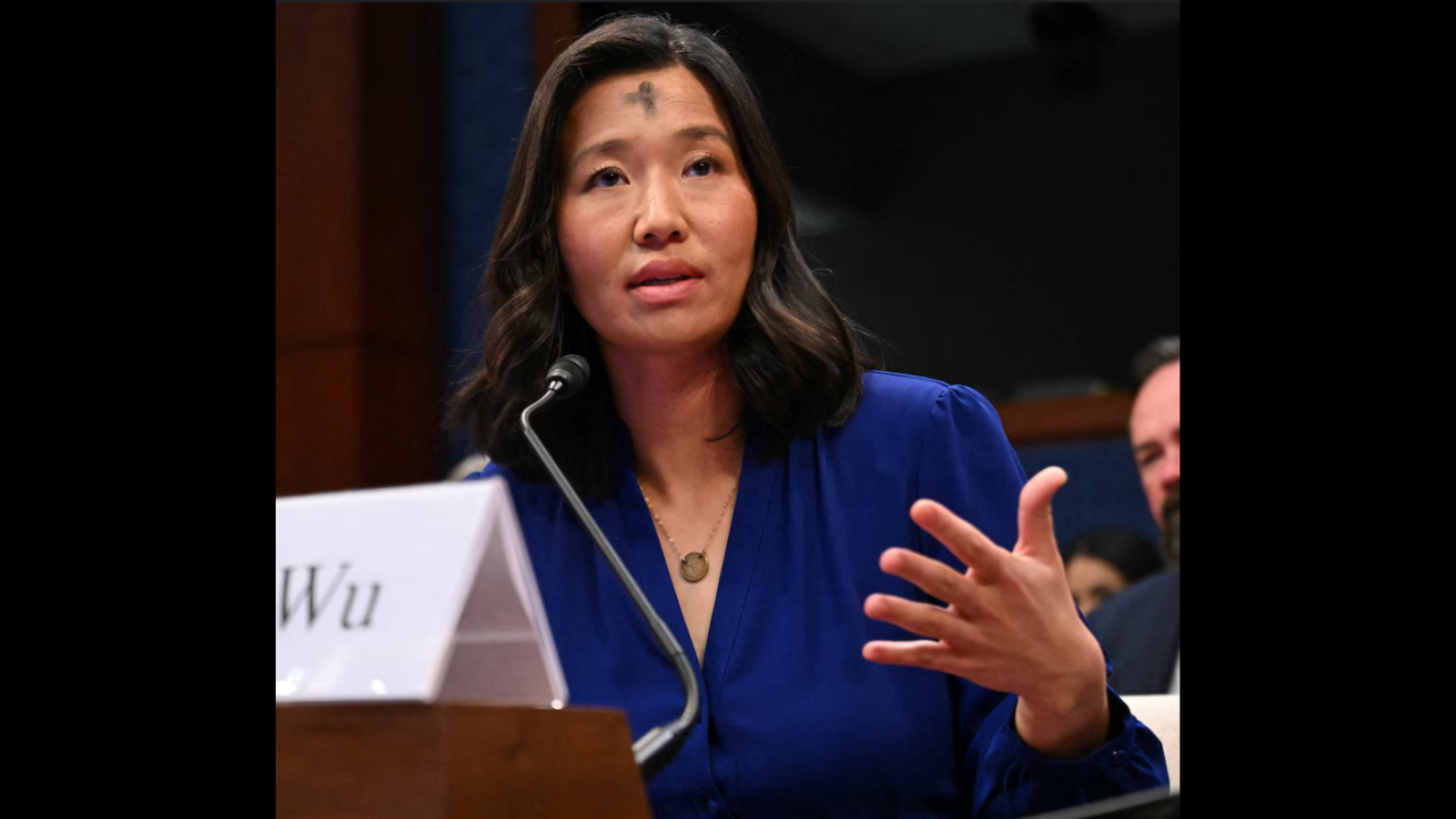
BOSTON — Mayor Michelle Wu stormed onto the progressive social media platform BlueSky this week to lash out at federal authorities after civil rights investigators opened a probe into Boston’s housing programs, responding with political rhetoric and finger-pointing as the city faces a fast-approaching federal deadline.
The outburst followed confirmation that the U.S. Department of Housing and Urban Development has launched a civil rights investigation into whether Boston’s housing policies unlawfully discriminated against white applicants. Federal officials have given City Hall just 10 days to respond.
A social media counterattack
Rather than engage with the substance of the investigation, Wu dismissed the probe as “baseless” and framed it as a partisan attack, invoking President Trump and portraying federal scrutiny as politically motivated.
In her posts, Wu highlighted her administration’s housing record and accused federal officials of undermining civil rights protections. The response was sharp and defiant — heavy on accusations, light on explanation.
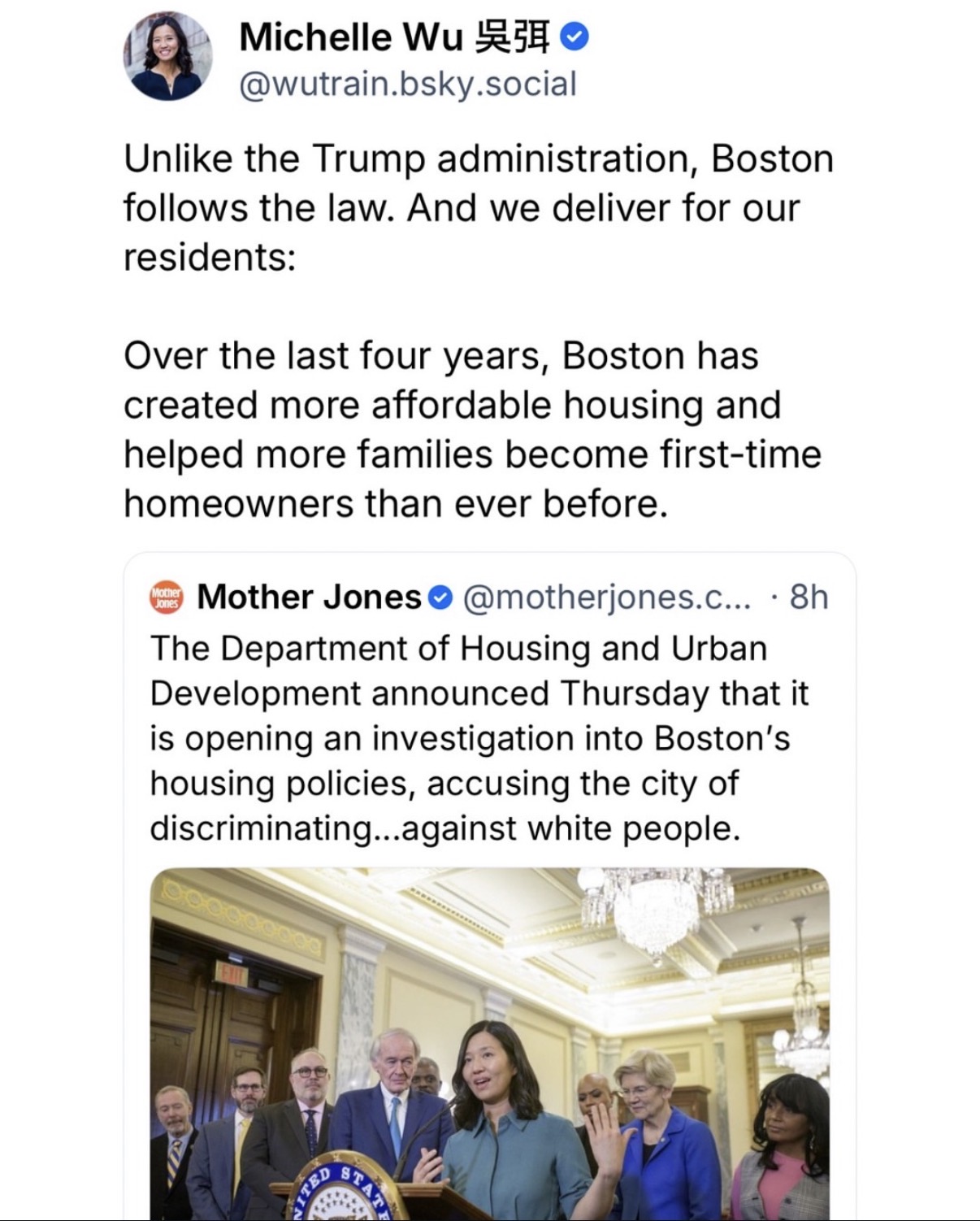

Mayor Michelle Wu took to BlueSky to fire back at federal civil rights investigators examining her administration’s housing policies.
What triggered the investigation
Federal investigators are examining Boston’s Anti-Displacement Action Plan, a housing framework adopted under Mayor Michelle Wu that uses demographic data — including race, ethnicity, and English-language prevalence — to determine where housing protections, enforcement, and policy interventions are prioritized.
Internal city materials tied to the plan identified “priority neighborhoods” based in part on those characteristics, while areas with higher concentrations of white, English-speaking residents were treated as lower priority. That design raised questions about whether the policy crossed a legal line under federal housing law.
MASSDAILYNEWS
STAY UPDATED
Get Mass Daily News delivered to your inbox
ADVERTISEMENT · Interested in advertising?
ADVERTISEMENT · Interested in advertising?
The issue now under review is whether the plan moved beyond analysis and outreach and into race-based decision-making — something federal law does not permit, regardless of intent.
HUD has given Boston 10 days to explain how the policy complies with the Fair Housing Act and to provide supporting documentation.
What Wu didn’t address
Instead of confronting the policy questions at the center of the investigation, Wu’s response read more like a reflexive deflection — pointing outward and shifting blame rather than engaging with the substance. The mayor framed the probe as politically motivated and invoked President Trump, a move that resembled a child insisting it was their sibling’s fault rather than answering what actually happened.
The analogy fit the moment: lots of finger-pointing, little explanation. Wu did not dispute the mechanics of the Anti-Displacement Action Plan, did not deny that race and language were built into its design, and did not outline how the policy complies with federal law. What she offered instead was a change of subject.
Federal investigators, however, are not evaluating rhetoric. They are reviewing documents, criteria, and decision-making — and with a 10-day deadline now ticking, the investigation is proceeding whether City Hall chooses to engage seriously or not.
Scrutiny didn’t come out of nowhere
The Anti-Displacement Action Plan has been under scrutiny since its rollout.
ADVERTISEMENT · Interested in advertising?
ADVERTISEMENT · Interested in advertising?
Months before federal investigators stepped in, the policy drew attention for how it categorized neighborhoods using race and English-language prevalence — an approach that raised questions about whether certain communities were being deprioritized based on demographic traits rather than need alone.
That scrutiny spread beyond Boston after early coverage by Mass Daily News highlighted the plan’s structure and criteria. The reporting circulated nationally and reached legal and political circles, prompting public reactions — including a notable “Hmm” response on X from Harmeet Dhillon, a senior federal civil rights official — signaling that concerns about the policy had traveled well outside City Hall.
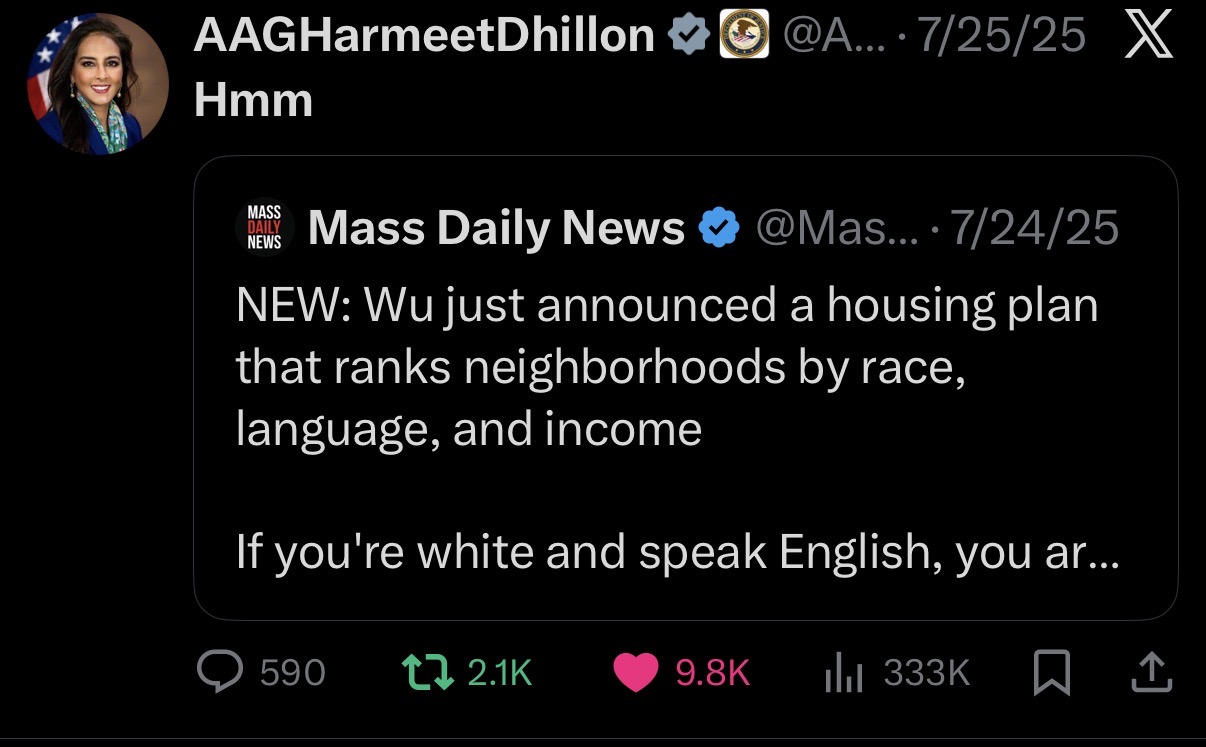
Harmeet Dhillon, a senior federal civil rights official, reacts to a July Mass Daily News report on Boston’s housing policy.
By the time HUD opened its investigation, the plan had already been debated at a national level, with its design and implications drawing attention long before federal enforcement formally began.
Federal pressure, political theater
As HUD presses for answers and documents, Wu has opted to wage her response in public.
Rather than laying out a legal defense of the Anti-Displacement Action Plan, the mayor has taken to social media, attacking the investigation’s motives and framing it as partisan while federal officials prepare to evaluate the city’s compliance.
With a 10-day deadline now ticking, the investigation is moving forward regardless of the mayor’s rhetoric. Federal civil rights officials will soon decide whether Boston’s housing policy withstands scrutiny — or whether the response from City Hall only deepens the trouble ahead.
Loading Comments